Best Trail Camera for Public Land: 7 Picks That Survive Theft, Weather, and Pressure
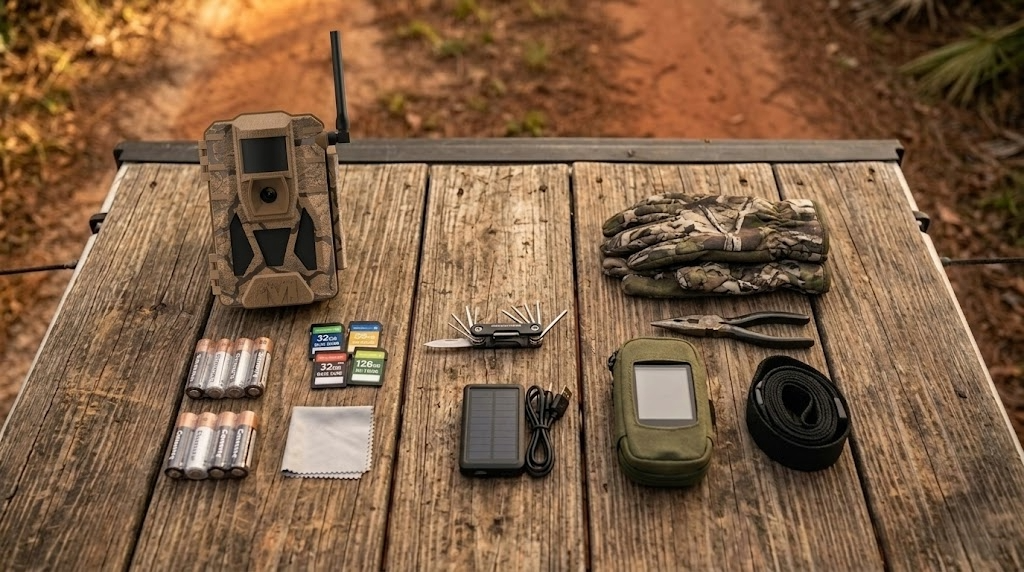
Running trail cameras on public land is a completely different game than hanging one on a private food plot and checking it every Sunday. On public ground, every visit to your camera risks leaving scent, bumping deer off their pattern, and tipping off other hunters to your spot. The camera itself is at risk, too. Theft is real. So is vandalism. And if your camera dies three weeks into a season because the batteries gave out or the cellular connection dropped, you just wasted your best scouting window.
The best trail camera for public land isn't the one with the highest megapixel count or the flashiest app. It's the one that stays hidden, stays connected, stays powered, and sends you the intel you need without requiring you to walk in there every other week. I've run cameras on state forests, game areas, and walk-in hunting tracts across Michigan for years. Some of these units are still sending photos. Some of them got stolen. Some of them just stopped working. Here are the ones worth your money.
Quick Picks: Best Trail Cameras for Public Land
Best Overall for Public Land: Muddy Matrix 2.0. Dual-carrier cellular, monster battery life, dark low-profile housing. Under $80.
Best Compact Profile: Tactacam Reveal X 2.0. Smallest cellular camera I've used, internal antenna, very hard to spot. Around $120.
Best Anti-Theft Protection: Spartan GoLive 3 4G/LTE. Built-in GPS tracking that works even if the antenna is removed. $300+ range.
Best Image Quality: Stealth Cam Spectre 4K Dual-Core. True 4K photos, dual-core processor, strong night flash. Around $120.
Best for States That Ban Cellular: Stealth Cam DS4K. No cellular transmission, 32MP, fast trigger, compact. Around $90.
Best Set-and-Forget: Bushnell CelluCORE 20 Solar. Integrated solar panel for all-season power. Around $140.
Best for Serious Budgets: Moultrie Mobile Edge Pro. Solid cellular performance at the lowest entry price. Around $50.
Muddy Matrix 2.0: Best Overall Trail Camera for Public Land
The Muddy Matrix 2.0 is the camera I'd buy if I had to run three units across a state land and couldn't afford to lose sleep over any of them. The dark matte housing blends into the bark without casting a reflective glare. The 16 AA battery tray, loaded with lithium cells, will run for the better part of a year in photo mode. And the dual-SIM auto-connect feature picks the strongest signal from Verizon or AT&T at your location.
I've had these out in southwest Michigan for a full season. Neither has been touched, and neither has missed a connection. The 0.4-second trigger speed catches deer cleanly on trail crossings, the 36MP daytime photos give you enough detail to pick out individual bucks, and the Command Pro app handles on-demand photo requests and camera sharing with hunting partners.
The 12V external tree again until you're ready to hunt the spot.
Limitations: Night photos are good but not top-tier. The camera is heavier than compact competitors when loaded with 16 batteries. The battery tray is stiff to remove in cold weather.
Best for: The public land hunter who wants reliable cellular scouting at a price where running three or four cameras doesn't break the budget.
Price: $80
Tactacam Reveal X 2.0: Best Compact Trail Camera for Public Land
If staying hidden is your top priority, the Reveal X 2.0 is the smallest, lowest-profile cellular camera I've put on a tree. The antenna is internal, so there's no stub sticking out of the top advertising "trail camera here" to every hunter who walks past. The matte case tucks into the crotch of a tree at 12 feet and all but disappears.
I've run two of these for two full seasons. Neither has been noticed. The trigger speed and image quality sit just below the Tactacam X-Pro, which is fine for the price. You're trading a little performance for a much smaller package.
Limitations: Smaller battery compartment means shorter runtime than the Matrix 2.0. Plan on battery swaps every 2 to 3 months in moderate use. Night flash range is shorter, so this works best on tight trails and scrapes, not wide field edges.
Best for: High-pressure public land where other hunters regularly walk through your area, or any spot where the risk of theft is elevated.
Price: Around $120.
Spartan GoLive 3 4G/LTE: Best Anti-Theft Trail Camera for Public Land
The Spartan GoLive 3 costs more than everything else on this list, and there's one feature that justifies the price for public land hunters who've been burned before: built-in anti-theft GPS. If someone takes your camera, the GPS tracker stays active even if they rip off the antenna or pull the batteries, thanks to an internal backup lithium battery. You can track the camera's location through the Spartan app. That alone has saved gear for hunters I know.
Beyond the theft protection, the GoLive 3 is a genuinely premium camera. Live video streaming at up to 30 frames per second lets you watch your spot in near real time. The 96-degree field of view covers more ground than most cameras, and the multi-carrier auto-connect handles automatic switching between Verizon and AT&T. The no-glow infrared flash is invisible to deer and humans.
Limitations: Price. At $300+, this is a serious investment that stings if someone does manage to walk off with it despite the GPS. Data plans add up, especially if you use the live stream feature regularly. The camera body is larger than compact options.
Best for: Hunters who've had cameras stolen before and want both deterrence and recovery. Also strong for anyone managing leased ground with shared access.
Price: $300+.
Stealth Cam Spectre 4K Dual-Core: Best Image Quality for Public Land
If the whole point of your camera is knowing exactly which buck is on your spot, the Spectre 4K delivers the sharpest photos of any camera in this roundup. The dual-core processor runs the trigger and cellular upload as separate tasks, so the camera doesn't lag when a deer walks through mid-transmission. Daytime 4K photos are sharp enough to count individual points, and the no-glow infrared flash does better work after dark than most cameras at this price.
The Command Pro app is shared across the Stealth Cam and Muddy lineup, so if you're already running a Matrix 2.0, the Spectre 4K slides right into the same account and app interface.
Limitations: Bigger housing makes concealment trickier on public land. 4K video chews through your data plan if you don't dial back resolution for routine surveillance. The price sits at the upper edge of the mainstream cellular market.
Best for: Hunters who want to inventory and identify individual bucks on public land stands, especially on spots where you've confirmed a mature deer and want detailed documentation.
Price: Around $120.
Stealth Cam DS4K: Best Non-Cellular Trail Camera for Public Land
Here's something most gear articles won't tell you: some states have banned cellular trail cameras on public land. Others ban all trail cameras during certain seasons. If you hunt in one of those states, or if you just want a cheap, reliable camera you can afford to lose, a good non-cellular unit still earns its spot in your pack.
The Stealth Cam DS4K is a compact, 32MP camera with a fast trigger, a no-glow flash, and a price under $80. The housing is small and dark, the detection circuit is reliable, and the image quality holds up well for an SD-card camera. You won't get photos on your phone, but you will get solid intel every time you swap the card.
Limitations: No cellular means you have to physically visit the camera to retrieve photos, which means more trips in, more scent, and more risk of other hunters finding your setup. Battery life is good but not exceptional compared to 16-battery cellular units.
Best for: States that restrict cellular cameras on public land, budget-conscious hunters who want to deploy five or six cheap cameras across a large area, or anyone who treats trail cameras as expendable tools.
Price: Under $90.
Bushnell CelluCORE 20 Solar: Best Set-and-Forget Trail Camera
The integrated solar panel on the CelluCORE 20 Solar is the feature that sells this camera for long deployments. Mount this on a south-facing tree with decent sun exposure, and the solar panel keeps the batteries topped off for an entire season. I ran one of these from June through December, and the battery indicator never dipped below half.
The cellular connectivity, image quality, and app experience are all solid for a mid-range device. Nothing flashy, nothing broken. The camera connects to Bushnell's own cellular service, which is reasonably priced compared to some competitors.
Limitations: The solar panel won't keep up in deep timber or heavily shaded creek bottoms. If your best public land spots are in thick cover, the solar advantage disappears, and you're left with a standard battery-powered camera that's bigger because of the panel. Night images are average.
Best for: Field edges, food plots, power line cuts, and other semi-open spots on public land that get regular sun exposure.
Price: Around $140.
Moultrie Mobile Edge Pro: Best Entry-Level Cellular Camera
If $130 feels like too much to risk on public land, the Moultrie Edge Pro gets you into cellular scouting at the lowest price point that still delivers reliable performance. The auto-connect system picks between Verizon and AT&T; the app is functional once you get past the initial learning curve; and Moultrie includes a free trial of its data plan so you can test cellular scouting before committing to monthly costs.
Daytime images are better than the price suggests. Battery life on 16 AAs runs around 4 to 5 months of moderate activity.
Limitations: Night photos are noticeably grainier than the Matrix 2.0 or Tactacam units. Trigger lag is a hair slower, so you'll get a few rear-end shots on fast-moving deer. The app takes a weekend to figure out.
Best for: First-time cellular camera buyers who want to test the concept before investing in more expensive units.
Price: Around $50.
What Makes a Trail Camera Good for Public Land
Public land places different demands on a trail camera than a backyard food plot does. Here's what to prioritize when you're choosing a camera for state forests, WMAs, and walk-in areas.
Low Profile
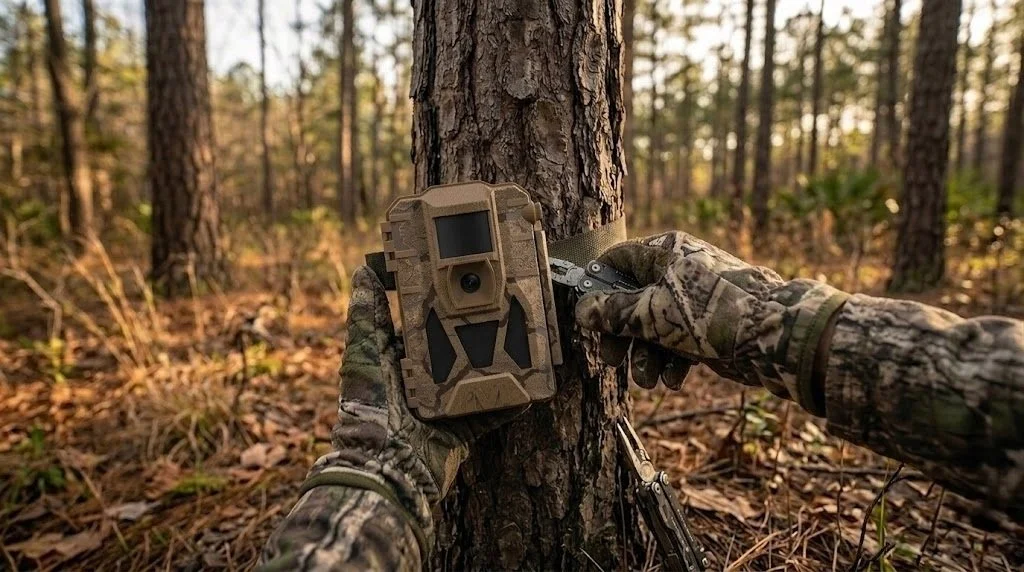
A dark, matte housing with no shiny surfaces is the starting point. Internal antennas are better than external ones for concealment. Small cameras are harder to spot than large ones. Everything about your camera should say "I'm part of this tree" to anyone walking past. Bright logos, reflective latches, and external antenna stubs are liabilities on public ground.
Cellular Connectivity
Every trip to swap an SD card leaves a scent, makes noise, and risks alerting other hunters. Cellular cameras eliminate most of those visits. Dual-carrier auto-connect (Verizon and AT&T) is worth the premium over single-carrier units because cell coverage on public land is unpredictable. Check coverage maps for your specific hunting area before buying.
Battery Life
Longer battery life means fewer visits. Cameras with 16-battery trays and external power jacks give you the longest runway. Lithium AA batteries outperform alkalines in cold weather by a wide margin. Budget for lithium batteries for every camera you run in the field from October through January.
Theft Deterrence
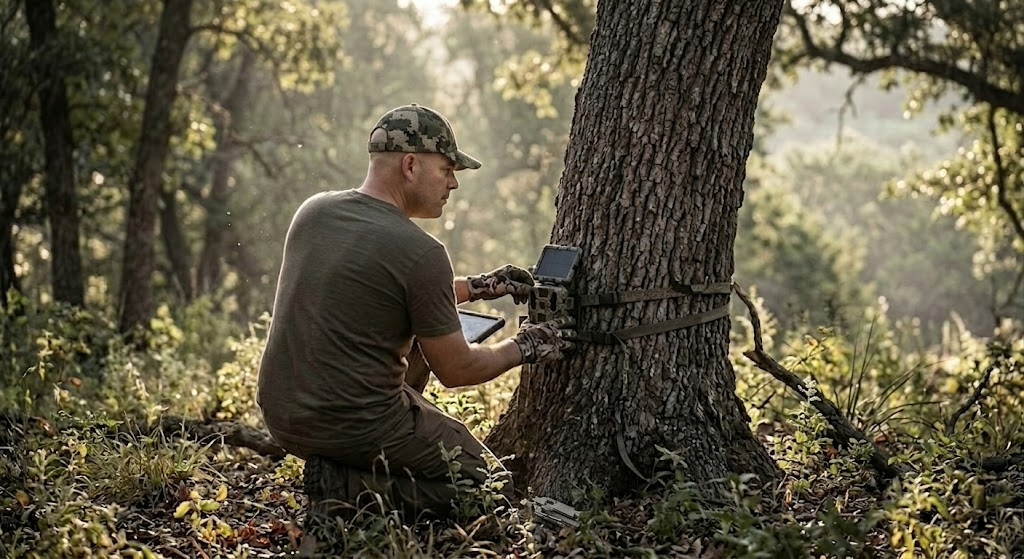
Mount cameras at least 10 feet up the tree, angled down. Use a Python cable lock through the camera's lock provision and around the tree. Set cameras back 15 to 20 feet from the trail so they're not at eye level for passing hunters. Anti-theft GPS, like the Spartan GoLive 3, offers you recovery options if theft does happen.
What Doesn't Matter as Much
Megapixel count beyond 12MP is mostly marketing. The difference between a "36MP" and "32MP" trail camera is almost entirely due to software interpolation, not to real sensor quality. Video resolution above 1080p is nice, but drains batteries and data plans faster with minimal practical benefit for scouting. Features like time-lapse mode and multi-shot burst are useful in specific situations, but shouldn't drive your buying decision.
Budget Pick Spotlight: Muddy Matrix 2.0
The Muddy Matrix 2.0 is the budget pick on this list and the overall pick. That doesn't happen often in gear reviews. Most of the time, the best value and the best performer are two different products. The Matrix 2.0 closes that gap because the features that matter most on public land, battery life, dual-carrier connectivity, low-profile housing, and external power compatibility, are all present at a price under $80.
Here's the math. Three Muddy Matrix 2.0 cameras cost about the same as one Spartan GoLive 3. For most public-land hunters, covering three spots beats having a single premium camera on a single tree. You get more data across more terrain, and if one camera gets stolen, you're out $100, not $300.
The battery life is the real differentiator. A 16-battery tray loaded with lithiums runs for 10 to 16 months, depending on photo volume and temperature. That's a full hunting season, from summer scouting through late-season sits, without a single battery swap. On public land, where every visit is a risk, that kind of runtime is worth more than any spec sheet number.
Frequently Asked Questions
Are trail cameras legal on public land?
Legality varies by state, and the rules are changing fast. Some states allow all trail cameras on public land year-round. Some ban cellular cameras but allow non-cellular units. Some ban all cameras during certain seasons, and a few have banned trail cameras on public land entirely. Always check your state wildlife agency's current regulations before placing a camera on public ground. The rules can change from one season to the next.
How do I keep trail cameras from getting stolen on public land?
Mount the camera 10 to 12 feet up the tree using screw-in tree steps. Angle the camera down toward the trail at about a 30-degree tilt. Use a Python cable lock through the camera's lock provision and around the trunk. Set the camera 15 to 20 feet back from the trail so it's not at eye level for passing hunters. Choose dark-housed cameras with no visible logos or reflective surfaces. Avoid placing cameras near parking areas, trail intersections, or any spot with heavy foot traffic.
Should I use cellular or non-cellular cameras on public land?
Cellular, whenever your state allows them. The ability to scout from your phone instead of walking to the camera saves you trips that leave scent and alert other hunters. Each visit to an SD card camera is a small erosion of the spot's value. If your state bans cellular cameras on public land, a compact, non-cellular unit like the Stealth Cam DS4K is the next-best option. Just plan your card swaps for midday when deer movement is low, and other hunters are less likely to be in the woods.
How many trail cameras should I run on public land?
Three is a good starting number for a single hunting area. Place one on your best entry trail to monitor what's passing through, one on the nearest active scrape or sign, and one on a secondary trail or terrain funnel 200 to 300 yards away to understand the bigger movement pattern. More cameras give you more data, but each camera is also a piece of gear that someone can find. Balance coverage with the risk of discovery.
What's the best time of year to set trail cameras on public land?
Late June or early July. Deer are in summer patterns, hunting pressure is zero, and you have two to three months of data collection before archery season opens. Setting cameras right before the season means you're learning about deer the same week you need to make decisions about where to sit. By getting cameras out in summer, you know which trees hold mature deer well before opening day.
Ready to find public land worth running cameras on? Subscribe below for free state-by-state public land hunting guides with maps, access tips, and the kind of on-the-ground scouting intel that helps you pick the right spots before you ever set foot in the woods.
