Why Your Best Food Plot Plans Should Start Now

The guys who shoot mature deer en route to their plots in November started thinking about those plots in April. That's not romantic. The calendar just works against anyone who waits until August to plan. Soil amendments need months to react. Seed blends run out. Equipment breaks at the worst moment. Weather windows shut without warning. If you're starting to think about food plots right now, you're in the sweet spot.
After 25 years of managing ground in southwest Michigan, the pattern's the same every year. Plots that turn into killing fields by late October get planned, prepped, and partially executed before Memorial Day. Plots that fail get planned the weekend before planting.
Why Planning Now Matters for Your Habitat
Food plots aren't a weekend project. They're a year-round system that rewards patience and punishes shortcuts. When you start planning in April or May, you have time to do the work the right way rather than improvising in the August heat.
Here's what early planning buys you:
Time for soil amendments to react. Lime takes six months or longer to shift pH. If your soil tests come back in late July, you're planting into the same acidic ground you had last year.
Access to the seed you actually want. Popular blends like Whitetail Institute's Tall Tine Tubers and soil-health mixes from Vitalize Seed run thin by mid-summer. Order in spring and you get first pick.
Equipment troubleshooting time. A broken sprayer found in April is an annoyance. The same broken sprayer found in August costs you a planting window.
Weather flexibility. When you're ready to plant and the window opens, you go. When you're scrambling for supplies, one bad forecast ruins the year.
There's also the habitat side. Deer, turkeys, pollinators, songbirds, rabbits, and every other critter that uses your property don't wait for your schedule. The sooner you're working your plots and cover, the better the whole system performs.
Site Selection and Soil Prep
Start by walking your ground. Look at last fall's plots with fresh eyes. Where did the deer hit hard? Where did weeds win? Where did standing water kill your seedlings? That walk tells you more about what to change than any magazine article.
Soil Testing First, Always
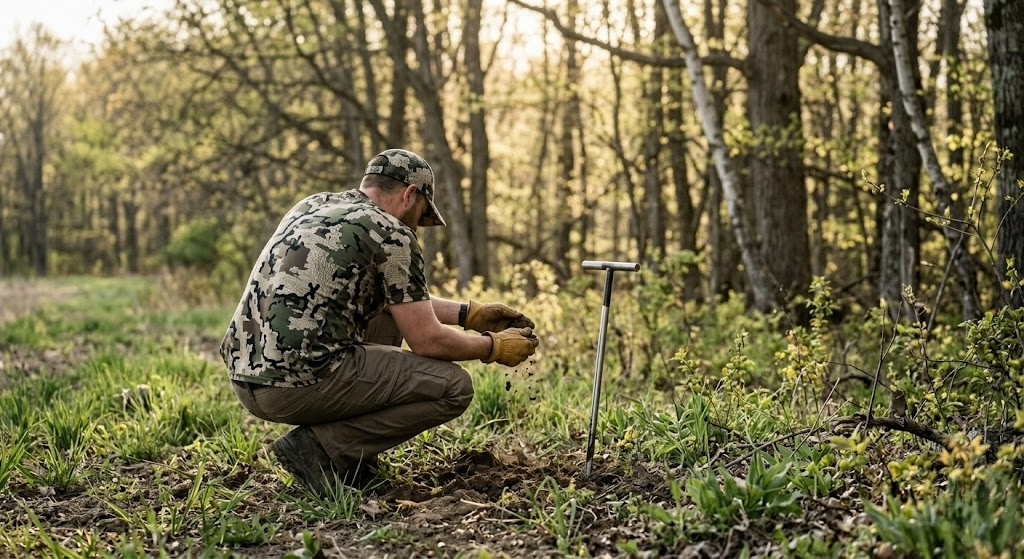
Pull samples from every plot you plan to plant this year. A proper soil sample means taking six to eight subsamples across the plot, mixing them together, drying them, and sending them to a reputable lab. Logan Labs and Waypoint Analytical both do solid work. Your state extension service also runs tests cheaply, but you often get less detail back.
The target pH for most food plot species ranges from 6.5 to 7.0. Clover, alfalfa, brassicas, and soybeans all want that range. Cereal grains tolerate a little more acidity, down to 6.0. If your pH is 5.5 or lower, you're fighting the ground every year.
Lime and Fertilizer Timing
Ag lime typically goes down at 1 to 3 tons per acre, depending on your starting pH. Pelletized lime works if you're spreading with an ATV spreader. The cost runs three to four times more per acre, and the chemical reaction is the same.
Apply lime now, in spring, even if you're planting a fall plot. The six-month reaction window means lime spread in April is working for you by October. Lime spread in August is still sitting on the surface when the deer show up.
Fertilizer is a different game. Most N-P-K applications occur at or near planting, since nitrogen volatilizes and phosphorus locks up in the soil over time. Plan the purchase now and apply at seedbed prep.
Your Month-by-Month Planting Plan
Here's how a realistic planning and planting calendar shakes out for a mid-latitude property. Adjust earlier for southern ground, later for northern.
April: Foundation Work
Soil test every plot you plan to plant.
Order lime and schedule delivery or spreading.
Frost-seed red clover into thin perennial stands at 4 to 6 pounds per acre.
Walk your property and map this year's plot locations.
May: Spring Planting and Equipment
Plant or overseed perennial clover at 7 to 10 pounds per acre, seeding depth 1/4 inch.
Check your sprayer, disc, cultipacker, and ATV spreader. Fix what's broken now, not in August.
Apply glyphosate burndown on summer plot sites two to three weeks before planting.
Order fall seed. Brassicas, cereal rye, and annual clover all sell out by mid-summer.
June: Summer Plots and Native Grass
Plant soybeans at 50 to 60 pounds per acre, 1 to 1.5 inches deep.
Plant switchgrass and other native warm-season grasses from June 1 through June 25 in the upper Midwest. I plant mine in southwest Michigan around June 10 to 15 at 6 to 8 pounds pure live seed per acre, with hybrid sorghum as a nurse crop at 3 to 5 pounds per acre.
Treat switchgrass stands with simazine at planting for broadleaf control, then Drive XLR8 in year two if fescue's a fight.
Plant sorghum, sunflowers, and buckwheat for summer plots and pollinator strips.
July: Fall Plot Prep
Apply glyphosate burndown on fall plot sites three to four weeks before planting.
Mow existing summer growth short to aid decomposition.
Run final soil adjustments if you skipped spring lime.
Confirm seed delivery for August plantings.
August: The Big Planting Window
Plant brassica blends the first week in August for northern zones, mid to late August for mid-latitudes, based on your first frost date. Target 5 to 6 pounds per acre, 1/4 inch deep.
Plant Tall Tine Tubers or similar brassica-heavy blends at 4 pounds per acre.
Overseed clover into thin perennial plots.
September: Last Call
Plant cereal rye and winter wheat at 100 to 125 pounds per acre if brassicas missed the window.
Broadcast annual clover over rye stands for a nitrogen-fixing cover.
Mow and assess summer plots that have been hit hard.
Establishment Timeline: Years 1, 2, and 3+
Year 1: Patience and Weed Pressure
Most perennial plantings look mediocre in year one. That's normal. Clover spends the first summer putting down roots. Native grasses put almost everything underground. If your plot looks 30 percent weeds in July of year one, you're on track, not failing.
Annuals are different. Brassicas, beans, and cereals perform in the year you plant them. That's why most managers run a mix of annual and perennial plots.
Year 2: Hitting Stride
Perennial clover closes canopy in year two if you've done your job with pH, fertility, and weed control. Switchgrass starts showing visible cover by midsummer. Alfalfa stands produce real tonnage. This is the year your planning pays off.
Year 3 and Beyond
Peak production for well-managed perennials. Clover plots last 4 to 6 years with overseeding and selective herbicide. Switchgrass stands run 10 to 15 years with fire or mechanical renovation. Alfalfa typically rotates out around year 5.
Maintenance: Mowing, Burning, and Weed Control
A food plot without maintenance becomes a weed patch within two seasons. Plan your maintenance calendar alongside your planting calendar.
Mowing Clover
Mow perennial clover when broadleaf weeds get 6 to 8 inches above the clover canopy. Set the deck at 6 to 8 inches, so you clip weed heads without scalping the clover. Stop mowing by mid-August, so clover can build root reserves for winter.
Selective Herbicides
Clethodim knocks out grass in clover without hurting the clover. Apply at 8 to 12 ounces per acre with crop oil. 2,4-DB handles broadleaf weeds in established clover. For switchgrass, simazine at planting and Drive XLR8 in established stands cover most weed problems.
Prescribed Fire
Native warm-season grasses, such as switchgrass, benefit from fire every 3 to 5 years. I burn my switchgrass at year 4, usually in late March or early April, before green-up. A clean burn resets thatch, kills invading cool-season grasses, and recycles nutrients. If you've never burned before, work with your state forestry agency or a certified prescribed fire contractor the first time.
Common Mistakes That Kill Your Season
Waiting until July to soil test. By the time results come back, you've lost your lime reaction window.
Planting into dry ground. If the top 2 inches are dust, wait for a forecast of rain.
Skipping lime because the plot looked fine last year. Soil pH drops a tenth to two-tenths per year under row crops. Last year's fine is this year's problem.
Over-planting small acreage. A three-acre property won't support a row-crop-scale soybean plot that the deer can survive on. Plant perennial clover and let beans grow on the farm next door.
Ignoring weed pressure in year one. A few broadleaves become a canopy by year two. Stay ahead with mowing and selective herbicides.
Cheaping out on seed. Bargain blends often include low-germ seed, weed seed, and filler. The cost-per-acre difference between premium and budget blends disappears when you compare yield and longevity.
How This Fits the Bigger Picture
Food plots are one leg of a three-legged stool. Food, cover, and water all have to work together. A property with world-class plots and zero bedding cover produces daylight deer movement for about two days before the neighbors hear shots and your deer disappear.
When you plan your food plots in April, you're also planning your cover. Switchgrass bedding fields go in during the same window as your summer plots. Timber stand improvement, hinge cuts, and edge-feathering projects happen in late winter through early spring. Water holes, mineral sites, and access trails get built when the ground's dry in May and June.
Recommended Products to Order Now
The seed and amendment decisions you make in April shape your whole season. Here's what earns a spot on my property every year.
For perennial clover, I run Whitetail Institute, Imperial Whitetail Clover. Seven pounds per acre on properly limed ground produces a stand that holds deer from April through December in years two and three. Downside: requires active mowing and herbicide maintenance to outperform cheaper blends over the long term.
For fall brassica plots, Whitetail Institute Tall Tine Tubers at 4 pounds per acre pulls deer hard from late October through the first hard freeze. The plot extends the hunt into late December in warm winters. Downside: single-species plots get hammered by disease in consecutive years. Rotate.
For diverse annual plots and cover-crop rotations, Vitalize Seed puts out blends worth a look. Their soil-health-focused mixes work especially well on tired ground that needs rebuilding. Downside: less familiar to most hunters than the legacy brands, so troubleshooting resources are thinner.
For switchgrass and native grass plantings, I source pure live seed from regional suppliers and run hybrid sorghum as a nurse crop. Your state conservation department often sells native grass seed at cost through CRP programs if you want a budget option.
For spraying, a 25-gallon ATV boom sprayer handles most small-acreage food plot work. Fimco ATV sprayer setup or similar. Downside: 25 gallons fills out fast on a 5-acre plot. If you're managing more than 10 acres, step up to a 40 or 60-gallon pull-behind.
For soil testing, Waypoint Analytical and Logan Labs both turn around comprehensive reports in 7 to 10 days. Your state extension service runs basic tests for $15 to $25 if you just need the pH and major nutrients.
The common thread across every product on this list: order now. The late-summer scramble for lime, seed, and sprayer parts is a brutal way to learn that habitat work is a long game.
Ready to get this year's property dialed in? Subscribe below for free state-by-state public land hunting guides and practitioner-level food plot walkthroughs delivered straight to your inbox. One email a week, zero fluff.
