My Honest Take on the One-Buck Rule: Why It's the Wrong Conversation
The Michigan one-buck rule debate comes back around every few years, and every few years, the same fight breaks out. Supporters say a one-buck rule will protect young bucks and push hunters toward does. Opponents say it punishes successful hunters and tramples tradition. Both sides dig in, the Natural Resources Commission takes public comment, and Michigan deer management drifts another year without a real answer.
But if you've been anywhere near Michigan hunting media this week, you've seen it. WNEM, CBS Detroit, Deer & Deer Hunting, WTV, the proposed one-buck rule is everywhere, and the Natural Resources Commission is scheduled to vote on it on May 13. This is no longer a hypothetical. It's a real proposal on a real timeline, and hunters across the state are being asked to take a side.
I've been asked what I think. Here's the straight answer.
What a Michigan One-Buck Rule Would Actually Do
A one-buck rule, by itself, would probably produce a small bump in antlerless harvest in the southern Lower Peninsula. Not a big one. The research from Wisconsin and across the Midwest is pretty clear that traditional regulatory tweaks move harvest numbers by single digits, not double digits. Hunters who want a big buck will keep passing young ones, whether they have one tag or two. Hunters who shoot the first legal buck they see will keep doing that, too. A one-buck rule doesn't rewrite hunter behavior. It nibbles at the edges.
That doesn't make it a bad idea in the right place. In the southern Lower, where deer densities are high, EHD outbreaks keep reminding us that the herd is too big for the country it lives in, and that crop damage and vehicle collisions are chronic problems; a one-buck rule could be a useful piece of a herd-reduction strategy. The keyword is piece. It's not a silver bullet. It's one tool among several, and it only makes sense where the biology actually calls for it.
Michigan Has Three Deer Herds, Not One
That's where the whole debate goes off the rails, because Michigan keeps trying to apply statewide rules to a state that clearly has three different deer herds.
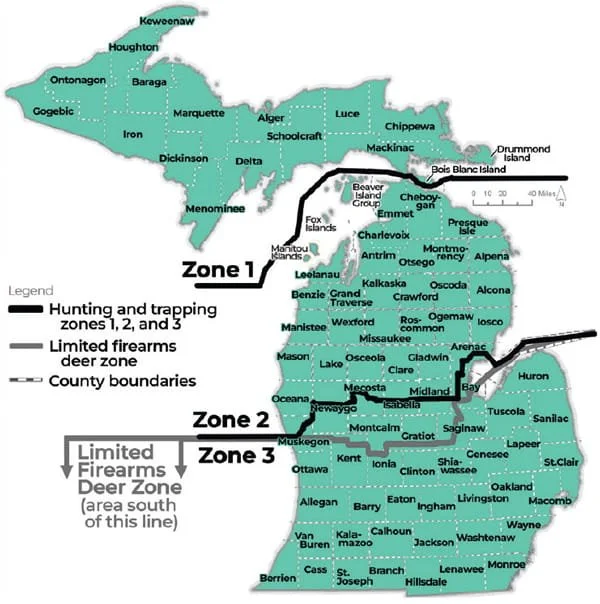
The southern Lower (Zone 3) is overabundant. The northern Lower (Zone 2) is mixed country with moderate densities and a strong local appetite for better buck age structure in some areas. The UP (Zone 1) is a northern-edge herd facing harsh winters, predation, aging habitat, and declining hunter participation. These are three different management problems, and they deserve three different management answers. Treating them like one herd is how we've ended up with regulations that satisfy nobody and deer management that drifts further from biological reality every year.
What Michigan Should Actually Do
Southern Lower Peninsula: One-Buck Rule, Tied to the Real Problem
In the southern Lower, adopt a one-buck rule. Tie it to the real problem: too many deer, chronic EHD outbreaks, and a herd that's outgrown its country. Pair it with generous antlerless tag allocations and a firearm opener moved to the last Saturday in November, which extends the effective hunting season into December, when deer concentrate on food sources. Let hunters focus their effort when it matters most. Possibly even work in Earn a Buck.
Northern Lower Peninsula: Combination Tag with Antler Restriction Criteria
In the northern Lower, keep the combination tag, one tag, valid for a legal buck meeting regional antler restriction criteria or an antlerless deer. Make the hunter choose at the moment of truth. This is the region where local support for buck age structure management is strongest, and a combo tag restructures the decision without forcing anyone into a rule they didn't ask for. Move the firearm opener to the third Saturday in November to align it with the end of peak rut.
Upper Peninsula: Combo Tag, No Antler Restrictions
In the UP, they would also run a combination tag, but without antler restrictions. UP deer have smaller antlers at given ages due to nutritional and winter constraints, and a point-count rule that works downstate would cut too deeply into available harvest up north. Move the firearm opener to the first Saturday in November. It catches the rut closer to peak, beats the worst of the weather, and respects deer camp culture that's built on a weekend anchor.
Fund It Through Region-Specific Licensing
And fund it properly through region-specific licensing. A hunter who hunts one region buys one regional license at a fair price. A hunter who wants two regions buys two. A hunter who wants all three pays for the privilege. License dollars follow the herd they support. Data follows the hunter to the region they actually use. Enforcement gets clearer because the license itself tells the DNR officer which rules apply.
The Real Conversation Michigan Isn't Having
This isn't a small change. It's a structural rethink of how Michigan manages its deer herd, and it asks more from hunters than the current system does. But it also gives back something the current system can't, management that actually matches the deer you're hunting. The UP hunter gets rules built for the UP. The southern Lower Hunter gets rules built to address the overabundance problem he sees every time he drives to work. The northern Lower Hunter gets the buck age structure its community has been asking for without forcing it on a state that doesn't uniformly want it.
The one-buck rule debate isn't wrong. It's just too small. Michigan has three herds, three hunting cultures, and three sets of problems, and we've been debating statewide regulations for twenty years while the real questions go unasked.
Time to ask them.
Michigan One-Buck Rule FAQ
Does Michigan have a one-buck rule?
No. Michigan currently allows licensed deer hunters to harvest two bucks per year under the combination license, with antler-point restrictions that vary by deer management unit. A statewide one-buck rule has been proposed multiple times but has not been adopted.
Would a one-buck rule grow bigger bucks in Michigan?
By itself, not much. Research from Wisconsin and the broader Midwest shows that single-regulation changes move harvest numbers in single-digit percentages. Buck age structure improves more from antler restrictions and habitat than from tag count alone.
Why does Michigan need different deer rules by region?
Michigan has three biologically distinct deer herds. The southern Lower Peninsula is overabundant and is dealing with chronic EHD outbreaks. The northern Lower has moderate densities and a local appetite for better buck age structure. The Upper Peninsula faces hard winters, predation, and aging habitat. One statewide rulebook can't serve all three.
When is the Michigan firearm deer opener?
Michigan's firearm deer season currently opens statewide on November 15th. Several proposals, including the regional approach outlined above, would shift the opener to better align with rut timing and weather patterns on each peninsula.
Get the Free Michigan Public Land Hunting Guide
Want practitioner-level breakdowns of Michigan's state game areas, national forests, and best public hunting by region? Subscribe below for free state-by-state public land hunting guides, including the full Michigan rundown.
