Summer Food Plots: A Warm-Season Planting Guide That Sets Up Fall Hunting Success
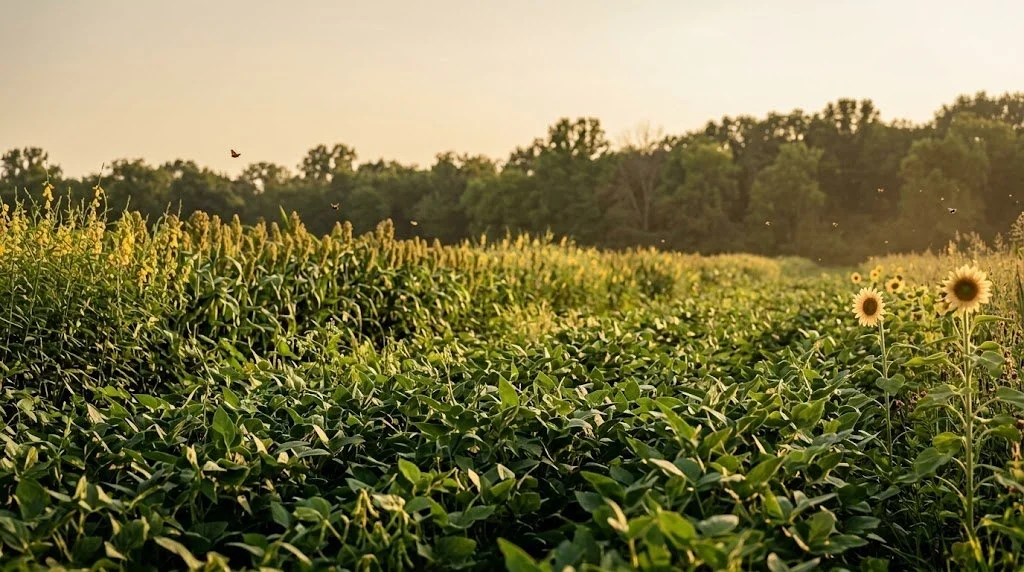
What you plant in the first week of June drives what your bucks look like in the first week of November. Summer food plots aren't a placeholder between spring green-up and fall brassicas. They're the engine that builds body condition, antler mass, and fawn recruitment on your property. If you skip the warm-season window, you're handing your neighbor's ground the best 90 days of the deer's nutritional year.
This is a hands-on guide for planting summer food plots that work. We'll cover the soil temperature trigger, regional planting windows, soil prep, a warm-season blend with proportions, five planting methods, and how a strong summer plot sets up your fall hunting before opening day. For more on year-round habitat strategy, check the food plots and habitat hub.
Why Summer Food Plots Matter More Than Most Hunters Think
Late July through early September is the worst nutritional gap most deer face all year. Native browse quality crashes in the heat. Forbs go to seed. Woody growth gets tough and tannin-heavy. At the same time, bucks are pushing peak antler growth, and does are still nursing fawns. The deer that come through this gap in good condition show up healthy in October. The ones that struggle through it show up thin, with average antlers, and with weaker fawn survival.
A working summer food plot fills that gap. It puts high-protein, high-mineral forage on the ground when natural food drops off. And it keeps your deer on your property when they have plenty of other places to go.
The 60°F Trigger: When to Actually Start Planting
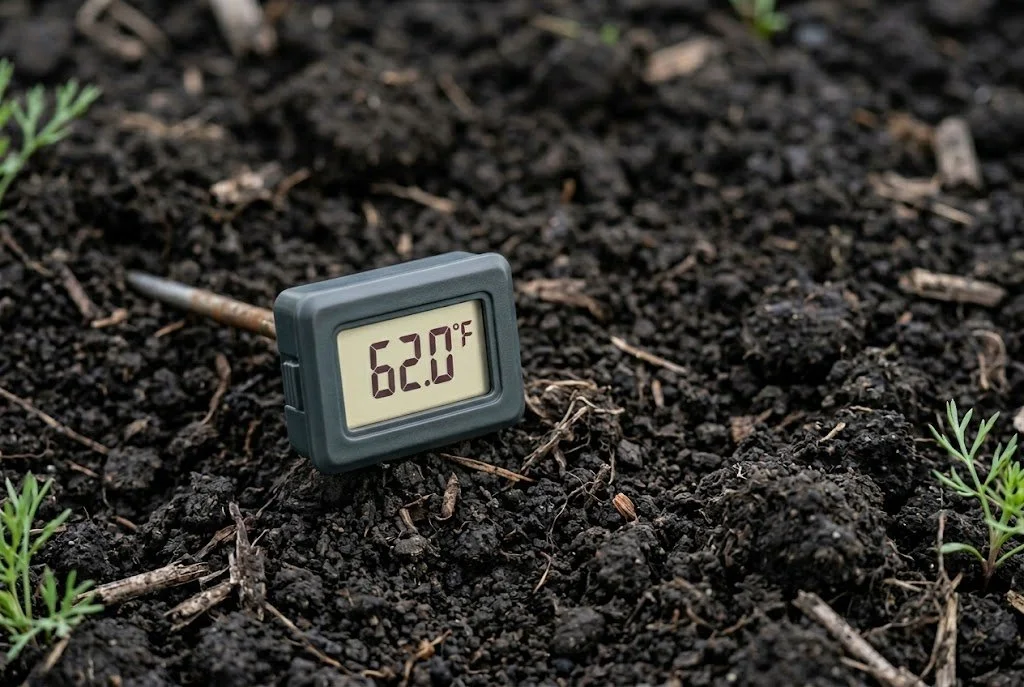
Warm-season legumes and grasses won't germinate well in cold soil. Plant too early and you'll watch your seed sit there, rot, or get eaten by birds and rodents. The trigger you're watching for is soil temperature at 2 inches deep, sustained at 60°F and rising.
Buy a soil thermometer. They run about 12 dollars at any hardware store, and they'll save you from replanting an entire field. Push it into the dirt about 2 inches deep, in a spot with average sun exposure, and check it at the same time of day for 3 days in a row. If your readings are climbing through 60°F, you're clear to plant.
Don't go by calendar date alone. A cold, wet May in Michigan looks very different from one in Tennessee.
Regional Planting Windows for Warm-Season Plots
The general window runs from April through June. Where you fall inside that window depends on your latitude and your spring weather.
Deep South (zones 8-9): Mid-March through early May. Soil warms early, but watch for late frosts on tender legumes.
Mid-South (zone 7): Early April through early June. Tennessee, Kentucky, southern Virginia, and northern Mississippi. Reliable window with good rainfall.
Midwest (zones 5-6): Late April through mid-June. Ohio, Indiana, Missouri, southern Iowa, and Illinois. The sweet spot for most properties.
Upper Midwest (zones 4-5): Mid-May through late June. Michigan, Wisconsin, Minnesota, and northern Iowa. This is where I plant most of my own ground in southwest Michigan.
Far North (zones 3-4): Late May through June. North Dakota, far northern Minnesota, and upper Wisconsin. Tighter window, less margin for error.
Aim for the early end of your window if you have time. Earlier plantings get more growing season, more biomass, and more rain through the establishment phase.
Soil Prep: Don't Waste Your Seed
The single biggest reason summer food plots fail is bad soil prep. You can buy the best seed in the world, and it won't do anything if your pH is 5.2 or your seedbed is loose and dry.
Start With a Soil Test
Pull a sample from 8 to 10 spots in the field, mix them in a clean bucket, and send about 1.5 pounds to your land grant university extension office or a private lab like Waters Ag or Logan Labs. The test costs around $ 25 to $ 40 and tells you exactly what your dirt needs. Don't guess. Test.
For most warm-season legumes, you want a pH between 6.0 and 7.0. If you're below 6.0, plan to lime. Pelletized lime works fast on the surface but doesn't move deep. Ag lime is cheaper and incorporates better if you're tilling. Either way, lime takes 4 to 6 months to fully react, so plan ahead.
Fertilizer for Warm-Season Plots
Most species in a warm-season blend fix their own nitrogen through rhizobia bacteria on their roots. So you don't need much N. What you need is phosphorus, potassium, and the right pH. A typical recommendation runs 0-20-20 at 200 to 300 pounds per acre, but follow your soil test.
Inoculate Your Legume Seed
If your seed isn't pre-inoculated, buy the right rhizobial inoculant for soybeans, cowpeas, and lablab. It costs 8 to 15 dollars per acre worth of seed. Skipping inoculation drops your yield and your nitrogen fixation. Don't skip it.
A Warm-Season Blend That Pulls Its Weight
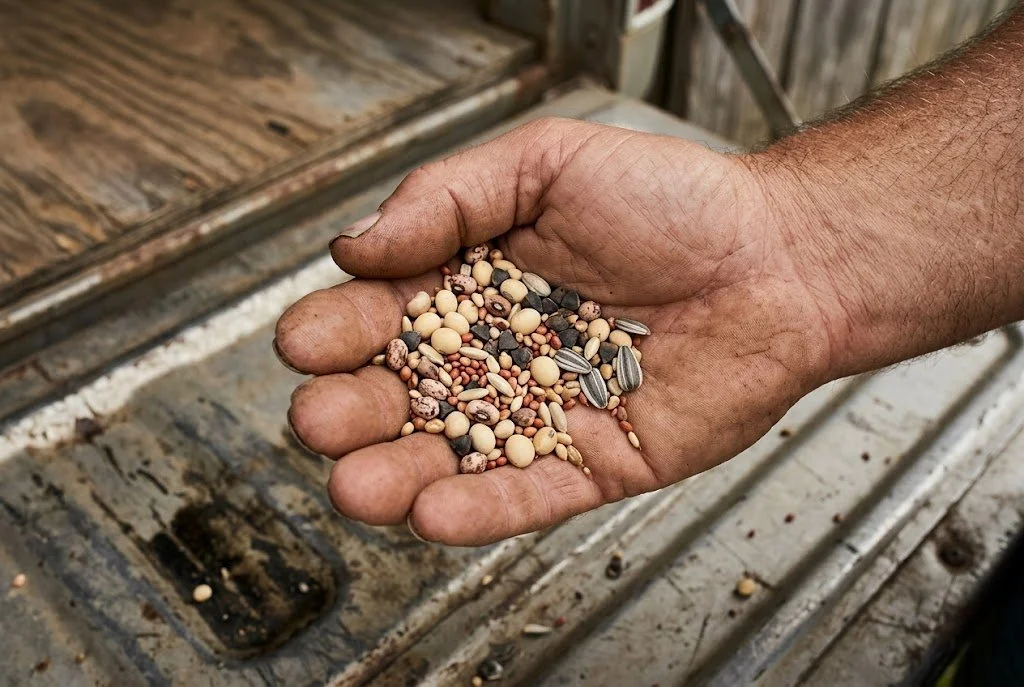
Diversity is the whole point of a warm-season summer plot. Different species fill different roles. Some grow fast and shade out weeds. Some fix nitrogen. Some hold up to browse. Some bridge into fall. A monoculture soybean plot can work, but a 12-species blend is more bullet-proof, more resilient, and produces better year after year.
Here's the proportions I run on my own ground, planted at roughly 45 to 50 pounds per acre total:
Forage Soybeans: 12 lbs per acre. Browse-tolerant, deep root, high protein. The backbone.
Forage Peas: 8 lbs per acre. Quick early growth, cool-tolerant on the front end.
Cow Peas: 6 lbs per acre. Heat and drought-tolerant. Carries when peas fade.
Sunn Hemp: 5 lbs per acre. Strong nitrogen fixer, vertical structure, deer browse the top growth hard.
LabLab: 4 lbs per acre. Slow to establish but durable through August heat.
Buckwheat: 4 lbs per acre. Germinates in 5 to 7 days, blooms in 30, suppresses weeds, and builds soil.
Hybrid Sorghum: 2 lbs per acre. A standing structure that holds up to fall.
Sudan: 1.5 lbs per acre. Tall cover, screens, and bridges into hunting season.
Sunflowers: 1.5 lbs per acre. Nurse crop, draws doves and songbirds, deer browse the leaves.
Crimson Clover: 1 lb per acre. A legume bridge that can persist into fall in mild zones.
Forage Rape: 0.5 lb per acre. Fall transition crop. Comes on strong as warm-season species fade.
American Joint Vetch: 0.5 lb per acre. Warm-season perennial legume, drought-tolerant.
Total: roughly 46 lbs per acre.
If you want a clean off-the-shelf option that nails this kind of diversity without weighing out 12 species yourself, Vitalize Seed Nitro Boost Spring Summer Blend is the bag I keep coming back to. The blend hits the same legume-grass-broadleaf balance and saves you about three hours at the bench.
One honest caveat. Any 12-species blend has tradeoffs. You won't max out any single species the way a pure soybean plot would. If your goal is just to grow soybean pods for fall, plant beans alone. If your goal is summer nutrition, weed suppression, soil building, and structure that carries into fall, run the diverse blend.
Five Planting Methods That Work
You have options. Pick the method that fits your equipment, your field conditions, and your tolerance for herbicides.
Broadcast
The simplest method. Spread the seed on a prepared seedbed, then pack or drag it in for soil contact. Bump your seeding rate 10 to 25 percent over drilled rates because some seed won't make ideal soil contact. This works on small plots where you don't have a drill.
Spread and Mow
Popular for hunters who don't want to use herbicides and don't have a crimper or cultipacker. Spread the seed first, then mow off the previous crop on top of it. The chopped vegetation falls over the seed, acting as mulch. Pray for rain. This isn't a great option if you have heavy weed pressure. It works very well when you're rotating between two complementary blends, like planting a warm-season mix into a stand of cool-season cover, or vice versa.
Spray and Seed
The cleanest method if you're fine with herbicides. Spray the existing vegetation with glyphosate or glufosinate. Let the spray dry fully. Drill or broadcast the seed into the standing dead vegetation. Then mow or roll it down onto the seed. The dead thatch traps moisture and shades emerging seedlings. If you've got real weed pressure, this is the method that gives you a clean stand.
Spread and Crimp/Crush
Plenty of folks want to skip the herbicide. If you have a roller crimper, lawn roller, cultipacker, or even a heavy drag harrow, you can try the spread-and-roll method. Spread the seed, then crimp, crush, or roll the existing vegetation flat over the top. Some operators still spot-spray after rolling to dry out the weed mat faster and improve kill rate. The crimped vegetation acts as a mulch layer, providing your seed with a moist, shaded place to germinate.
Conservation Tillage (Disc/Till)
If you still like to till or disc, that's fine. Any step toward soil conservation is a step in the right direction. The recommendation is conservation tillage, where you barely turn the soil and leave 30 percent or more of the surface covered with residue.
Lightly disc or vertical till the field
Spread the seed evenly
Pack with a cultipacker, lawn roller, or drag to firm the seedbed
Firm seed contact is the difference between a stand and a fail. You should be able to walk across the field and only sink in a quarter inch.
Seeding Rates and Planting Depths
For broadcast methods, increase your rates 10 to 25 percent over drilled rates. The seed amounts in the blend above already account for broadcast.
For depth, here's a rough rule for a mixed warm-season blend planted as a broadcast:
Effective depth target: 0.25 to 0.5 inch for the blend as a whole
Soybeans, peas, cow peas, lablab: 1 to 1.5 inches when drilled, 0.5 inch when broadcast and packed
Sunn hemp, buckwheat, sorghum, sudan, sunflowers: 0.5 to 1 inch
Crimson clover, forage rape, joint vetch: surface to 0.25 inch
For a broadcast blend, you're splitting the difference. Don't bury a clover seed an inch deep, but don't leave a soybean seed sitting on the soil surface either. Pack the seedbed firmly. Soil-to-seed contact matters more than perfect depth.
What Growth Looks Like Week by Week
Once you've got seed in the ground at proper soil temperature with adequate moisture, here's what to expect:
Days 0 to 7: Buckwheat, peas, and sunflowers up first. Soybeans and cow peas right behind them.
Week 2: Cotyledons on most species. Buckwheat 3 to 6 inches tall. The plot starts to look like something.
Week 3 to 4: Legumes branching. Buckwheat at 12 inches and starting to canopy. Sunn hemp and sorghum are showing up.
Week 5 to 6: Buckwheat blooming. Soybeans and cow peas at 12 to 18 inches. Sunn hemp is pushing 2 feet on good ground.
Week 7 to 10: Full canopy. Sunn hemp 3 to 5 feet. Sorghum heading. Sunflowers are starting to bloom. Peak summer forage.
Week 10 to 14: Soybean pod fill. Sunflowers in full bloom. Sudan at 5 to 6 feet. Crimson clover and forage rape fill in below the canopy.
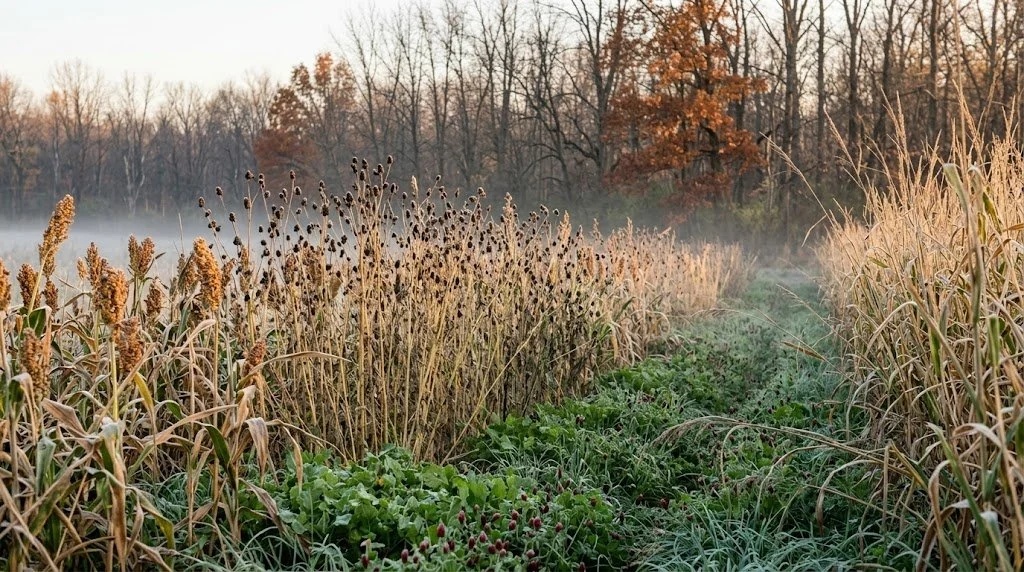
After the first frost, Tender species die back. Sorghum, sudan, and sunn hemp stand as residue. Forage rape and crimson clover keep producing into late October and November.
Photograph the plot every two weeks. Same angle, same time of day. By August, you'll know what works on your soil and what doesn't, and that data is gold for next year's planting decision.
How Summer Plots Set Up Fall Hunting
This is the part most hunters miss. Summer food plots aren't separate from fall hunting strategy. They are a fall hunting strategy.
Three things happen on a property with a strong summer plot that don't happen on properties without one.
First, deer pattern themselves to your ground. They learn the field in July, feed on it in August, and build daylight confidence in September. By the time you're sitting in a tree stand on October 12, those deer have spent 90 days getting comfortable with that food source. They know where they enter, where they bed, and where they feel safe.
Second, antler quality and body condition come into the season higher. A buck on a steady protein diet through July and August grows more antler. A doe in good condition heading into the rut breeds earlier and produces healthier fawns the following spring.
Third, the standing residue of sunn hemp, sorghum, and sudan creates structure in November. That residue screens deer movement, gives them confidence to feed in daylight, and lets you slip into a stand without skylining yourself across an open field. The residue also keeps a bridge of forage available when surrounding crops get harvested.
If you run a summer plot well, you're not hoping deer show up in October. You've already trained them to.
Mistakes That Kill Summer Food Plots
Planting too early. Cold soil rots the seed. Wait for that 60°F trigger.
Skipping the soil test. Lime takes months to react. Find out in March what you need so you can apply it in time.
Not inoculating legumes. A 10-dollar oversight that costs you 50 percent of your yield.
Burying seed too deep. A clover seed buried at 1.5 inches will never see daylight.
Planting too thin. If you don't get canopy closure by week 6, weeds will take over the field. Bump the rate, don't shave it.
Ignoring weed pressure. If your field has a serious weed seed bank, use the spray-and-seed method. Don't just throw seed and hope.
Forgetting the fall transition. Pure summer annual plots leave a gap when the first frost hits. Build forage rape and crimson clover into the blend so you have green forage into November.
Frequently Asked Questions
What's the difference between summer and fall food plots?
Summer plots are planted with warm-season species (legumes, sorghums, sunflowers) and provide protein and mineral nutrition during the antler-growth and fawning window. Fall plots are planted with cool-season species (brassicas, cereal grains, perennial clover) and serve as hunting attractants from October through January.
How big should a summer food plot be?
For nutritional value, aim for 2 to 3 percent of your huntable acres in a food plot, split between summer and fall. On a 100-acre property, that's 2 to 3 acres of food plot total. For a true summer nutritional plot, half an acre is the working minimum to handle browse pressure on most properties. Less than that, and the deer will graze it flat before it ever produces.
Can I plant a warm-season blend without herbicide?
Yes. The spread-and-mow method and the spread-and-crimp method both work without spraying, especially when you're rotating between two clean previous crops. The catch is weed pressure. If your field has heavy ragweed, foxtail, or thistle in the seed bank, you'll fight those weeds the entire summer. Spray-and-seed gives you a cleaner stand if you're willing to use glyphosate or glufosinate.
How long do summer food plots last?
Most warm-season species are annuals. They produce through the summer and into early fall, then die back at frost. The standing residue (sorghum, sudan, sunn hemp) holds structure through November and December. If you've worked crimson clover and forage rape into the blend, you'll have green forage into late fall, too. Plan to replant the field next May or rotate it to a fall blend.
Do I need a tractor to plant a summer food plot?
No. ATV-mounted seeders and sprayers handle most plots under 5 acres. A push spreader and a hand sprayer work for plots under an acre. The biggest bottleneck for small-equipment plots is firming the seedbed. A weighted lawn roller pulled behind an ATV does the job for most properties.
The Real Payoff Shows Up in November
The work you do this spring decides what your hunting property looks like in November. A diverse warm-season blend, planted at the right soil temperature, on a properly prepped seedbed, builds nutrition through the worst part of the deer's year. It anchors your deer to your ground. It builds antlers. It loads the gun for fall.
If you want help laying out summer plots on your property or evaluating where to put them, drone-based property scouting through ScoutFlight Hunting Assessments gives you the aerial perspective that changes how you think about field placement. Note: ScoutFlight Hunting Assessments is a sister brand operated by the same team behind LandsToHunt.com.
Lay Out Your Plots Before You Burn the Diesel
The hardest part of summer food plot work isn't planting. It's deciding where to plant. Wrong spot, wrong shape, wrong size, and you've spent a weekend, a tank of fuel, and 200 dollars in seed building a plot the deer hit twice and forget about.
Hunt Scout is a tool I built for exactly this kind of decision. You bring a property, and Hunt Scout walks the ground with you on the map, looking at terrain, cover, edges, and assessing the way an experienced land manager would walk it on foot. What you get back is a working planning view that highlights spots worth your closer attention and surfaces the layout questions you should ask before you clear a single stem of vegetation.
For food plot design specifically, Hunt Scout helps you think through four things most hunters get wrong on the first try:
Placement. Where a plot sits in relation to bedding, travel routes, prevailing wind, and your entry and exit makes the difference between a spot deer feed in daylight and a spot they only hit after dark.
Shape and size. A long, narrow plot along a timber edge plays very differently from a square plot in the middle of a field. You want to see options on a map before you commit equipment to the ground.
Plot system, not just one plot. Most properties want a working system of plots, a destination feeding plot, a smaller kill plot closer to bedding, maybe a screening strip on an access route. Hunt Scout lets you sketch the system and see how the pieces fit together.
Access angles. If you can't reach a stand on this plot without busting bedding cover, the plot is hurting you. Hunt Scout flags access concerns alongside the plot itself, so you're not designing a beautiful field you can never hunt cleanly.
What Hunt Scout won't do is tell you what seed to plant or guarantee a buck. That part's still on you and your soil test. What it will do is shorten the gap between "I think this might work" and "this is the plan I'm running with," which on a new property or a leased lease is the gap where most food plot money gets wasted.
For the ground you've hunted for fifteen seasons, you already know where the plots want to go. For everywhere else, the planning step is where the wheels come off. Hunt Scout exists to keep them on.
Try Hunt Scout for your food plot planning -> https://www.hunting-scout.com/
Get your free state-by-state public land hunting guides and our seasonal food plot planning calendar by joining the LandsToHunt email list. We send field-tested habitat tips, planting reminders, and honest gear reviews from working hunters who run this stuff on their own ground. Subscribe below.
