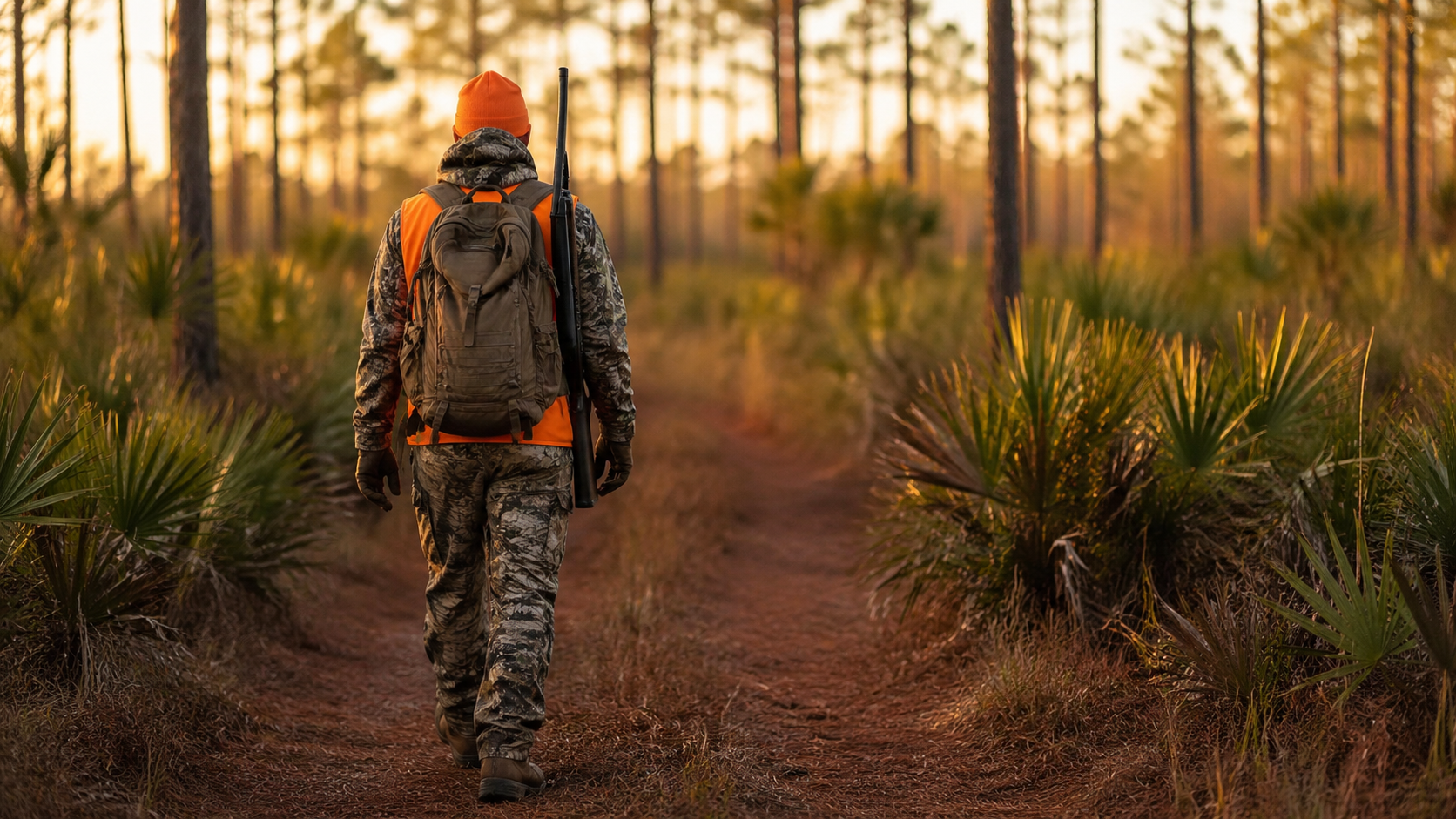
Georgia runs a public land hunting program that most hunters outside the Southeast don't take seriously, and that's their loss. The state manages more than 100 Wildlife Management Areas covering over a million acres, spread from the Blue Ridge Mountains in the north down through the Piedmont and into the coastal plain swamps along the Savannah and Altamaha rivers. The deer herd is strong, the turkey hunting is some of the best in the country, hog hunting is wide open, and the state offers public land access to species like alligator, quail on managed plantations, and coastal waterfowl that you won't find on public ground in most other states.
Public land hunting in Georgia rewards hunters who learn the state's quota hunt system. Georgia WMA hunting runs differently than the walk-in, hunt-anytime model you find in states like Pennsylvania or Wisconsin. Many of the best hunts are managed through a draw, with specific dates and limited tags. Once you understand how the system works and start applying strategically, Georgia gives you access to properties and deer herds that rival private land anywhere in the region.
How Much Public Land Does Georgia Have for Hunting
The numbers stack up better than most people expect:
Wildlife Management Areas: More than 100 WMAs totaling roughly 1 million acres, managed by the Georgia Department of Natural Resources, Wildlife Resources Division (GA DNR WRD)
Chattahoochee-Oconee National Forests: 866,000 acres across two national forests in north and central Georgia, managed by the U.S. Forest Service
National Wildlife Refuges: Several refuges, including Piedmont, Bond Swamp, Okefenokee, and Banks Lake, offer public hunting during specific seasons
Army Corps of Engineers lands: Scattered tracts around reservoirs like Hartwell, Clarks Hill, and Allatoona
State Parks with hunting: Select parks allow hunting in designated zones
Combined, you're looking at well over 1.5 million acres of public hunting land in Georgia. The WMA system is the centerpiece, but the national forests add massive acreage, especially in the mountain counties where the Chattahoochee stretches across some of the most rugged terrain in the eastern U.S.
Licensing is straightforward. Georgia residents pay $20 for a hunting license and $15 for a big game license (required for deer, bear, and turkey). Non-residents pay $150 for a hunting license and $75 for big game. Everyone hunting WMAs needs a free Georgia Outdoor Recreation Pass (GORP) and a WMA license ($19 for residents, $73 for non-residents). The WMA license is the key that opens the door to Georgia WMA hunting across every managed tract in the system. Quota hunt applications are submitted through the GA DNR GoOutdoorsGeorgia system, and most cost $5 to apply.

Top 12 Public Hunting Areas: The Best WMAs in Georgia and Beyond
These are the properties worth your time and application fees, covering every region of the state and a range of species.
Chattahoochee National Forest (Cohutta Wilderness and Rich Mountain Areas)
Managing agency: U.S. Forest Service
Acreage: 750,000 (entire forest), Cohutta Wilderness ~37,000
Region: Fannin, Gilmer, Murray, and surrounding mountain counties
Primary species: Whitetail, black bear, turkey, grouse, squirrel, hogs
Terrain: Steep mountain ridges, rhododendron-choked coves, hardwood slopes, laurel thickets, high-elevation creek drainages
Access: Open with a valid Georgia hunting license. No WMA license required for national forest land outside WMA boundaries. Dispersed camping allowed.
Insider tip: The Cohutta Wilderness is walk-in only with no motorized access, and most hunters don't go deeper than the first mile. Pack in two to three miles on Jacks River Trail and hunt the oak flats above the creek bends. Bear and mature bucks hold in the coves where nobody wants to drag an animal out.
Cedar Creek WMA
Managing agency: GA DNR WRD
Acreage: 30,900
Region: Putnam, Jones, and Jasper counties, central Georgia Piedmont
Primary species: Whitetail, turkey, feral hogs, small game
Terrain: Piedmont hardwood ridges, loblolly pine plantations, Lake Oconee shoreline, creek bottoms
Access: WMA license required. Mix of quota and non-quota hunts. Multiple boat ramps and road access points.
Insider tip: Cedar Creek holds some of the better bucks on public ground in central Georgia. The fingers of hardwood running between pine plantations create natural travel corridors during the rut. Hunt the transition zones between pine and hardwood, not the pine interior.
B.F. Grant WMA
Managing agency: GA DNR WRD
Acreage: 2,085
Region: Putnam County
Primary species: Whitetail (quality bucks), turkey
Terrain: Mixed Piedmont hardwood and pine, food plots, managed habitat
Access: Quota hunts only. Very limited tags.
Insider tip: B.F. Grant is a managed showcase property and one of the best WMAs in Georgia for quality bucks. The draw odds are tough, but the property produces deer in the 130-plus class regularly on public ground. Apply every year. When you draw, you're hunting a property managed like a private lease.
Chickasawhatchee WMA
Managing agency: GA DNR WRD
Acreage: 19,800
Region: Baker, Calhoun, and Dougherty counties, southwest Georgia
Primary species: Whitetail, turkey, feral hogs, quail
Terrain: Longleaf pine flatwoods, cypress swamp, hardwood hammocks, palmetto understory
Access: WMA license required. Non-quota archery and some quota gun hunts.
Insider tip: Southwest Georgia is quail country, and Chickasawhatchee's managed longleaf and wiregrass ecosystem holds wild birds that most public land in the state can't match. Bring a dog and spend a January morning on the pine flats. Deer hunting is good, but quail hunting is what makes this property special.
Altamaha WMA
Managing agency: GA DNR WRD
Acreage: 36,000
Region: Appling, Tattnall, Toombs, and Jeff Davis counties, southeast Georgia
Primary species: Whitetail, turkey, feral hogs, waterfowl
Terrain: River swamp, bottomland hardwood, pine uplands along the Altamaha River corridor
Access: WMA license required. Boat access opens up the best swamp hunting. Some areas flood seasonally.
Insider tip: Altamaha is big, wet, and intimidating, which is exactly why it holds good deer. The river swamp bucks bed on high-ground islands within the floodplain. Use a boat to access the river corridor and hunt the hardwood ridges that rise out of the swamp. A lot of hunters stick to the pine uplands and miss the best ground entirely.
Dawson Forest WMA
Managing agency: GA DNR WRD
Acreage: 10,200
Region: Dawson County, north Georgia foothills
Primary species: Whitetail, turkey, bear, hogs, squirrel
Terrain: Mountain foothills, hardwood coves, pine ridges, creek bottoms
Access: WMA license required. Heavily used by hikers and mountain bikers on the Amicalola tract, so scout hunting sections separately.
Insider tip: Dawson Forest is close to Atlanta and gets hammered on weekends. Weekday archery hunts in October are a different experience. The bike trail traffic pushes deer into the north-facing coves by mid-morning, and those coves hold animals that don't see hunters during archery season.
Di-Lane WMA
Managing agency: GA DNR WRD
Acreage: 8,700
Region: Burke County, east-central Georgia
Primary species: Whitetail, turkey, dove, quail, rabbit
Terrain: Managed pine plantation, agricultural fields, hardwood drains, dove fields
Access: WMA license required. Popular dove field draws and small game hunting.
Insider tip: Di-Lane's managed dove fields are some of the best public land dove hunting in the Southeast. The draws fill up fast, so apply early. Outside of dove season, the hardwood drains between the pine blocks hold deer that see almost no pressure once small game season winds down.
Cohutta WMA
Managing agency: GA DNR WRD
Acreage: 95,600
Region: Murray and Fannin counties, extreme north Georgia
Primary species: Whitetail, bear, turkey, hogs, grouse, squirrel
Terrain: Mountain ridges, cove hardwood, high-elevation oak forests, rhododendron thickets
Access: WMA license required. Overlaps with Cohutta Wilderness (national forest). Mix of quota and non-quota hunts.
Insider tip: Cohutta WMA is the best public land bear hunting in Georgia, and the acorn crop drives everything. Check the Forest Service oak mast survey in September and hunt the ridges where white oak is dropping. Bear season overlaps with deer, so you can sit in a stand with two tags in your pocket.
Sapelo Island WMA
Managing agency: GA DNR WRD
Acreage: 8,240
Region: McIntosh County, Georgia barrier island
Primary species: Whitetail, feral hogs
Terrain: Maritime forest, salt marsh, live oak hammocks, palmetto flats
Access: Quota hunts only. Ferry access from the mainland. Very limited tags.
Insider tip: Sapelo Island is a once-in-a-lifetime public land experience. The hunt is as much about the setting as it is about the deer. Bucks here are smaller-bodied than mainland Georgia deer, but you're hunting live oak hammocks on a barrier island with no vehicle traffic and no outside pressure. Apply every year. The experience alone is worth the trip.
Oconee National Forest (including Redlands WMA)
Managing agency: U.S. Forest Service / GA DNR WRD (Redlands)
Acreage: 116,000 (Oconee NF total)
Region: Greene, Morgan, Putnam, Jones, and Jasper counties, central Georgia
Primary species: Whitetail, turkey, hogs, small game
Terrain: Piedmont pine and hardwood, creek bottoms, old-growth pockets, lake edges
Access: National forest land open with a hunting license. Sections of the Redlands WMA require a WMA license and follow quota schedules.
Insider tip: The Oconee is broken into scattered tracts mixed with private land, which creates edge habitat that holds more deer per acre than the big contiguous mountain forests. The small, isolated tracts that are hard to find on a map are the ones that hold unpressured deer. A mapping app makes these scattered parcels findable.
Ossabaw Island WMA
Managing agency: GA DNR WRD
Acreage: 11,800
Region: Chatham County, coastal barrier island south of Savannah
Primary species: Whitetail, feral hogs
Terrain: Maritime forest, marsh edges, palmetto, live oak canopy
Access: Quota hunts only. Boat access from the mainland.
Insider tip: Ossabaw holds a very healthy hog population, and the hog hunts draw fewer applicants than the deer hunts. If you want to get on the island and experience coastal Georgia hunting, the hog hunt is your best bet. The island is also one of the few places in Georgia where you can hunt truly feral hogs in a wild barrier island setting.
Rum Creek WMA
Managing agency: GA DNR WRD
Acreage: 9,200
Region: Monroe County, central Georgia
Primary species: Whitetail, turkey, hogs
Terrain: Mixed Piedmont hardwood and pine, power line cuts, creek drains
Access: WMA license required. Quota and non-quota hunts.
Insider tip: Rum Creek sits in one of the better deer density zones in the Piedmont, and the power line rights-of-way cutting through the property create browse and travel corridors that funnel deer movement. Set up where a power line crosses a creek bottom, and you've got a natural pinch point.
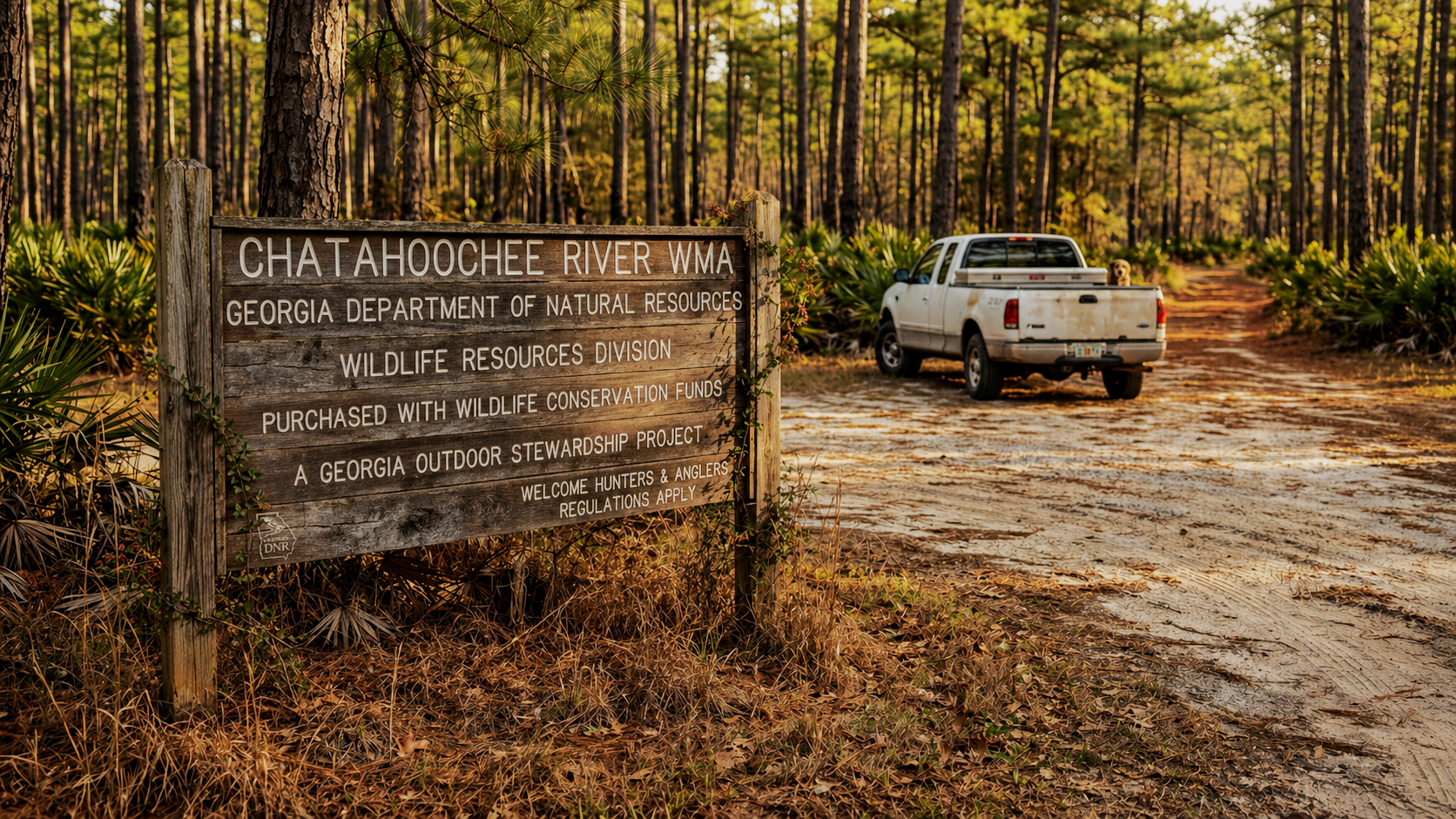
What You Can Hunt on Public Land in Georgia
Whitetail is the primary draw, and Georgia's deer herd is healthy across all three physiographic regions. The Piedmont and coastal plain produce the best body weights and antler growth because the soils are richer and the food is more diverse. Mountain deer are smaller-bodied but offer a big-woods hunting experience that appeals to a different kind of hunter.
Turkey hunting in Georgia is excellent. The state holds a strong Eastern turkey population, and the spring gobbler season runs from late March through mid-May. Public land turkey hunting on Georgia WMAs is some of the best in the Southeast, especially on the Piedmont and coastal plain properties where mixed hardwood and open ground create ideal strut habitat.
Feral hogs are open year-round on most WMAs during any legal hunting season, and there's no bag limit. Hogs are thick on the coastal plain and river swamp WMAs, and they're a great reason to get on new ground during the off-season or during small game hunts.
Black bear hunting is available in the north Georgia mountains through a limited season in September and October. Cohutta WMA and the surrounding Chattahoochee National Forest are the primary bear zones.
Waterfowl hunting hits on the coastal WMAs and along the major river corridors. Altamaha, the Savannah River corridor, and a handful of managed duck impoundments on WMAs give you public access to wood ducks, teal, and migrating mallards.
Alligator hunting is drawn on select WMAs and is one of Georgia's most unique public land opportunities. Tags are limited, and the draw is competitive, but someone pulls a tag every year.
Small game, including squirrel, rabbit, dove, and quail (wild birds on managed properties like Chickasawhatchee and Di-Lane), round out a species list that's deeper than most states can offer.
Season Structure and the Quota Hunt System
Georgia's deer season runs roughly from early September (archery) through mid-January (firearms), with exact dates varying by region. The state is divided into three deer season zones, each with its own opener and closer. Firearms season generally runs from mid-October through mid-January, depending on the zone.
Turkey spring season opens in late March and runs through mid-May. Fall turkey is available in select counties during a limited season.
The quota-hunt system is the defining feature of hunting in Georgia WMAs. Many of the best WMAs allocate deer, turkey, dove, waterfowl, and bear hunts through a drawing. You apply through the GoOutdoorsGeorgia system, pick your preferred hunts, and wait for results. Application fees are small, usually $5 per application. Draw results post several weeks before the hunt dates.
Non-quota hunts run on many WMAs during general season dates and don't require a draw, just a WMA license and the appropriate game license. These hunts get more pressure but still produce for hunters willing to work away from the crowds.
Dove field draws on managed WMAs like Di-Lane, which are a Georgia tradition and fill up fast. Apply early in the summer when applications open.
Access Tips for Georgia WMA Hunting
Georgia's WMA system has some specific rules that trip up out-of-state hunters and even some locals who haven't read the fine print:
Check-in and check-out. Most Georgia WMAs require you to check in at a sign-in board before hunting and check out when you leave. Some use physical kiosks at entry points. Others use the GoOutdoorsGeorgia app. Missing a check-in is a finable offense. Don't skip it.
Vehicle restrictions. On many WMAs, vehicles are restricted to designated roads only. Gates are locked on interior roads during certain seasons. If a gate is closed, walk. Getting your truck stuck behind a locked gate on a WMA is a bad day.
Camping. Camping rules vary by WMA. Some allow primitive camping in designated areas, some don't allow camping at all. Check the specific WMA regulations page on the GA DNR website before you plan an overnight trip. The national forests in north Georgia allow dispersed camping without restriction.
Orange requirements. During firearms deer seasons on WMAs, Georgia requires at least 500 square inches of fluorescent orange above the waist, including a hat. That's more than most states require, so check your gear before you go.
Harvest reporting. Georgia requires same-day electronic harvest reporting for deer, turkey, and bear through the GoOutdoorsGeorgia system. Report before you move the animal from the WMA.
Dog hunting. Dog hunting for deer is allowed on some WMAs during specific quota hunts. If you're a still-hunter or stand hunter and don't want dogs running through your area, check the WMA schedule and avoid dog hunt dates.
Gear That Works for Georgia's Terrain and Climate
Georgia's hunting seasons span from 90-degree September archery opens to 25-degree January mornings in the north Georgia mountains. Your gear has to flex across a huge temperature range and handle everything from swamp water to mountain rock.
Early-season heat management. September and October archery in Georgia is hot. Lightweight, breathable camo is mandatory. A moisture-wicking base layer like Sitka’s Core Lightweight base layer keeps you functional when it's 85 degrees at first light. Bring more water than you think you need. Heat kills hunts faster than anything in the Georgia woods.
Snake protection. Rattlesnakes, copperheads, cottonmouths. Georgia has all of them, and they're active well into November in the southern half of the state. Snake boots or gaiters are non-negotiable on any WMA south of Atlanta. LaCrosse Alphaburly Pro handles both the snakes and the swamp water on coastal plain properties.
Rubber boots for swamp WMAs. The river, swamp, and coastal WMAs like Altamaha and Ossabaw require wading through standing water. A knee-high rubber boot that drains and dries is your best friend. The LaCrosse Alphaburly Pro works here too, or go with a cheaper rubber boot you don't mind sacrificing to the mud.
Quiet outer layers for Piedmont hardwoods. Piedmont WMA deer hunting often means close encounters in mixed hardwood where sound carries. The KUIU Axis Hybrid jacket is quiet against branches and sheds enough weather for Georgia's mild winters. For a budget-friendly alternative, the First Lite Catalyst breathes well for active hunting.
Optics. Georgia timber is tight in the mountains and the Piedmont, but the coastal plain and pine plantations offer longer sightlines. A mid-range binocular like the Vortex Diamondback HD 10x42 covers both situations. Budget pick: the Vortex Crossfire HD 10x42 at around $150 gets the job done without hurting your wallet.
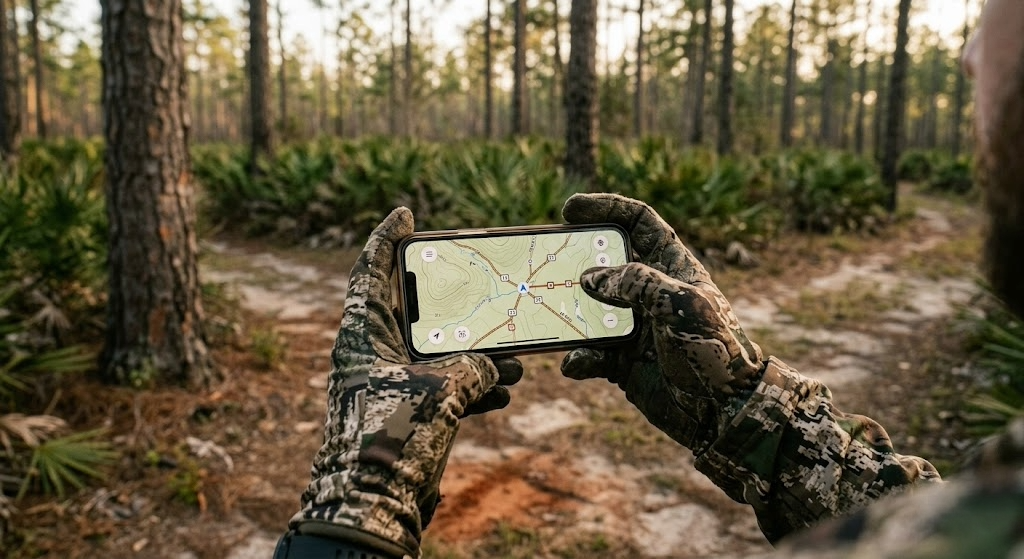
Mapping app.onX Hunt is essential for Georgia WMA hunting. WMA boundaries, property lines, and the scattered Oconee National Forest tracts are all loaded in. Knowing exactly where WMA land ends and private land begins prevents trespassing in a state where boundaries aren't always well-marked on the ground.
Finding Unpressured Ground on Georgia's Best WMAs
Georgia WMA hunting gets pressured, especially on the WMAs close to Atlanta, Macon, and Savannah. The opening weekend of firearms season on any accessible WMA will have trucks parked at every pull-off, and hunters spaced every 100 yards along the easy-walk ridges.
Your edge is distance and difficulty. On every Georgia WMA, pressure drops off dramatically past the first half mile from any road or parking area. Swampy creek bottoms that require a wade, steep north-facing coves in the mountains, and the far side of pine blocks away from any two-track all hold deer that see a fraction of the pressure.
E-scouting is the way to find these spots before you spend gas and boot leather. Pull up satellite imagery and look for three things: thick cover pockets surrounded by open pine (deer bed there), creek confluences with hardwood bottoms (deer feed and travel there), and any terrain feature that makes access difficult from the nearest road (deer survive there).
onX Hunt lets you layer WMA boundaries over topo and satellite imagery so you can plan approach routes that keep you on public ground while targeting spots other hunters won't reach. For a deeper analysis of bedding, travel, and food sources on a specific WMA or an adjacent tract you're considering, Hunting Scout uses AI to break down what a property is telling you about deer movement before you ever walk it.
Timing is the other lever. Non-quota hunts during the middle of the week see a fraction of the weekend pressure. If you can take a Tuesday or Wednesday off, you're hunting different ground than the Saturday crowd. Early archery season in September also draws far fewer hunters than the firearms opener, and deer patterns remain predictable around summer food sources.
Frequently Asked Questions About Public Land Hunting in Georgia
How much public hunting land is in Georgia?
Georgia has more than 1.5 million acres of public hunting land. When you combine WMAs (over 1 million acres), the Chattahoochee-Oconee National Forests (866,000 acres), National Wildlife Refuges, and Corps of Engineers land. The WMA system alone covers more than 100 managed properties across every region of the state.
What is a Georgia quota hunt?
A quota hunt is a drawn hunt on a specific WMA during specific dates with a limited number of hunters. You apply through the GoOutdoorsGeorgia system, pay a small application fee (usually $5), and wait for draw results. Quota hunts manage pressure and often produce better hunting quality than non-quota general season hunts. Some of the best WMAs in Georgia, like B.F. Grant and Sapelo Island are quota-only properties.
Do I need a WMA license to hunt Georgia's national forests?
No. If you're hunting Chattahoochee or Oconee National Forest land that is NOT also designated as a WMA, you only need a valid Georgia hunting license and the appropriate game license. If the national forest tract overlaps with a WMA (like Cohutta WMA inside the Chattahoochee), you need the WMA license for those areas.
Can non-residents hunt Georgia WMAs?
Yes. Non-residents buy a non-resident hunting license ($150), a big game license ($75), and a non-resident WMA license ($73). You're eligible for the same quota hunt draws and non-quota hunts as residents. There are no non-resident restrictions on which WMAs you can hunt.
What are the best WMAs in Georgia for big bucks?
B.F. Grant WMA (quota only, Putnam County) is the state's showcase quality-managed property. Cedar Creek WMA, Rum Creek WMA, and the Piedmont WMAs in general produce the best combination of antler growth and deer density. For the coastal plain, Chickasawhatchee and Altamaha hold good bucks in terrain that discourages casual hunters.
Is dog hunting allowed on Georgia WMAs?
Dog hunting for deer is permitted on select WMAs during specific quota hunt dates. The GA DNR WMA regulations booklet lists which properties and dates allow dog hunting. If you prefer to still-hunt or sit in a stand, check the schedule and plan your hunts around non-dog dates.
Can you camp on Georgia WMAs?
Camping rules vary by WMA. Some allow primitive camping in designated areas, and a few have established campgrounds nearby. Many WMAs don't allow camping at all. Always check the specific property regulations on the GA DNR website before planning an overnight stay. The Chattahoochee National Forest in north Georgia allows dispersed camping without a permit, which makes it the easiest option for hunt-camp trips.
When is the best time to hunt Georgia WMAs for deer?
The rut in Georgia generally peaks from late October through late November, with slight regional variation (earlier in north Georgia, later in the coastal plain). Early archery season in September offers low pressure and predictable deer on food sources. Mid-week non-quota hunts during November hit the sweet spot of rutting activity and low hunter density. For the least crowded experience, avoid the first week of firearms season on any accessible WMA.
Want the full breakdown of every Georgia WMA with quota hunt details, plus the same for all 50 states? Subscribe to the LandsToHunt newsletter below and get our free state-by-state public land hunting guides delivered to your inbox.
