KUIU vs Sitka: Which Hunting Clothing System Is Worth Your Money
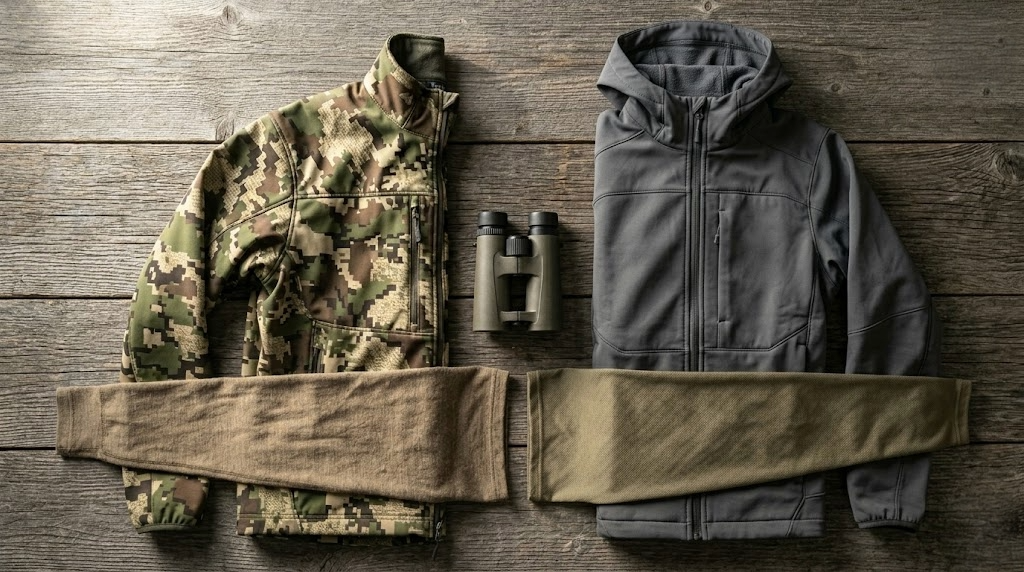
KUIU and Sitka are the two brands that dominate every "what should I wear hunting" conversation, and for good reason. Both make premium hunting clothing that outperforms anything you'll find at a big-box retailer. Both run deep product lines that cover base layers through outer shells across every season and every type of terrain. And both cost enough that choosing the wrong one hurts your wallet for a couple of seasons.
I've worn both brands extensively. KUIU is my primary system for whitetail and has been for years. I've hunted in the Axis Hybrid, the Peloton line (RIP to the 97), the ULTRA Merino, the Guide DCS, the Proximity, Encounter, and several of their packs. I've also spent meaningful time in Sitka's Core base layers, the Fanatic system, the Stratus, and the Jetstream jacket. I'm not neutral here, but I am honest. Both brands make excellent gear, and the right choice depends on how you hunt, what you prioritize, and where you're willing to compromise.
Quick Verdict by Category
Base layers: Sitka wins synthetic (Core Lightweight). KUIU wins merino (ULTRA Merino 145 with zip-off bottoms). First Lite beats both on merino odor control. Full base layer review here.
Mid layers: KUIU Peloton 200 and Sitka Fanatic are both strong. Sitka fits tighter for a dedicated whitetail layering system. KUIU fits more loosely for versatility across hunting styles.
Outer shells (whitetail): KUIU Axis Hybrid wins for quiet, weather-resistant all-around performance at a lower price. Sitka Stratus wins for pure late-season warmth but costs more. For stationary hunts, I throw the Proximity in my pack.
Outer shells (mountain/western): KUIU Guide DCS wins on value and weight. Sitka Jetstream wins out in durability on rough terrain.
Rain gear: Sitka Cloudburst is the benchmark. KUIU Yukon competes well at a lower price.
Packs: KUIU wins outright. Their pack line is deeper, lighter, and better designed for the money than anything Sitka offers.
Price: KUIU runs 15 to 25 percent less than Sitka on comparable pieces across nearly every category.
Category-by-Category Breakdown
Base Layers
KUIU discontinued the Peloton 97, which was the best synthetic base layer in hunting for several years. That leaves the Sitka Core Lightweight as the strongest synthetic base layer on the market right now. The Core Lightweight dries fast, fits clean under mid layers, and Sitka's Polygiene antimicrobial treatment gives it better odor control than most synthetics. At $109 to $135, it's not cheap, but the performance justifies the price for a single-day hunting base.
On the merino side, KUIU's ULTRA Merino 145 takes the edge. The Nuyarn construction makes the fabric tougher and faster-drying than traditional merino knits, and KUIU's zip-off bottom design lets you remove your base layer in the field without pulling off your boots. No other brand offers that. At $99 to $119, the ULTRA Merino also costs less than Sitka's merino options.
Honest take: If you run an ozone generator for scent control the way I do, merino's odor advantage shrinks to almost nothing. Once odor is handled externally, synthetics win on dry time and warmth per gram. In that case, the Sitka Core Lightweight becomes the better pick regardless of brand preference.
Mid Layers
KUIU's Peloton 200 is a synthetic fleece mid-layer that provides strong warmth for the weight and dries very fast. The fit runs slightly looser than Sitka's equivalent pieces, which gives you more room to layer a thick base underneath and still move comfortably. For hunters who wear their mid layer as a standalone on moderately cold sits in the 25 to 40 degree range, the Peloton 200 works well on its own with just a base underneath.
Sitka's Fanatic jacket and bibs are purpose-built for whitetail treestand hunting. The fit is tighter and more articulated than KUIU's mid layers, designed to work as part of a complete Sitka layering system without bunching or binding at full draw. The Fanatic uses Sitka's Gore Optifade Elevated II pattern, which is designed specifically for above-ground concealment (treestand and saddle hunting). If you're a dedicated whitetail treestand hunter building a complete system, the Fanatic fits and functions better as part of the Sitka stack.
Honest take: The Fanatic bibs are one of the best whitetail-specific garments on the market, and KUIU’s equivalent is the Proximity. If you hunt from a treestand or saddle in cold weather, the Fanatic bibs are worth crossing brands for, even if you run KUIU everything else.
Outer Shells: Whitetail
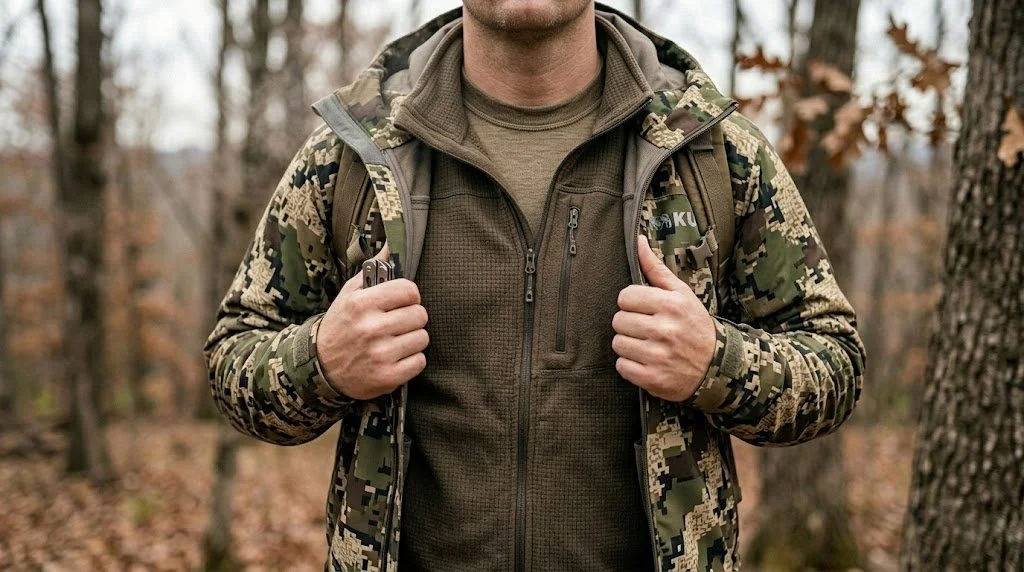
This is the category where I have the strongest opinion. The KUIU Axis Hybrid jacket is the outer shell I've run for whitetail hunting across multiple seasons in Michigan, and nothing else I've worn performs as well for the price. The soft-shell face is dead quiet against branches, thorns, and tree bark. The DWR finish sheds light rain and wet snow. The fit layers over a base and mid without restricting the draw. And the Vias camo pattern works in hardwood timber from September through January.
Sitka's closest competitor is the Stratus jacket, which is warmer, heavier, and more expensive. The Stratus uses Gore Windstopper fabric with PrimaLoft insulation, making it a mid-to-outer hybrid that works well on bitterly cold stationary sits. If you're sitting in a treestand in 15-degree weather for four hours, the Stratus outperforms the Axis Hybris on warmth. But the Stratus is too warm for anything above 35 degrees, it's louder against brush, and it costs about $100 more.
The verdict: The Axis Hybrid covers a wider temperature range and costs less. The Stratus is a better pure cold-weather piece but a worse all-around jacket. For most whitetail hunters who need one outer layer that works from October through January, the KUIU wins.

Outer Shells: Mountain and Western
For mountain hunts, backcountry trips, and western big game, KUIU's Guide DCS jacket and pants are the standard. The Guide DCS is a water-resistant-breathable hardshell that weighs less than most competitors, packs small, and sheds sustained rain and wet snow without wetting out. KUIU built its brand on mountain hunting, and the Guide DCS shows that heritage. The jacket runs $300 to $350, which undercuts Sitka's comparable pieces by a meaningful margin.
Sitka's Jetstream jacket is the mountain-hunting competitor. The Jetstream uses Gore-Tex Infinium with a soft-shell face, making it quieter and more comfortable against skin than a traditional hardshell. For spot-and-stalk western hunting where you need to move quietly through brush and timber, the Jetstream's soft-shell construction has an edge. But it's not as waterproof as the Guide DCS in sustained rain, and it costs more.
Honest take: If you hunt in the rain, the Guide DCS is the better jacket. If you hunt in dry mountain conditions where quiet movement matters more than waterproofing, the Jetstream earns the premium. For most DIY western hunters who face mixed conditions, KUIU's value proposition is hard to beat.
Rain Gear
Sitka's Cloudburst jacket and pants are the best rain gear for hunting. Full stop. The Gore-Tex Pro construction handles sustained downpours without wetting out, the articulated fit moves with you through brush and over deadfall, and the pack weight is reasonable for what you get. At around $500 for the jacket, you're paying for the best waterproof-breathable technology on the market.
KUIU's Yukon rain jacket is the value play. It runs about $100 less than the Cloudburst and performs well in moderate rain. In sustained heavy rain over several hours, the Cloudburst pulls ahead on breathability and waterproofing. For most whitetail hunters who face intermittent rain rather than all-day downpours, the Yukon does the job at a better price. For mountain hunters who will be in the rain for 8 hours on a ridge, the Cloudburst is worth the investment.

Packs
KUIU wins this category with no close competition from Sitka. KUIU built its brand around technical hunting packs before it made clothing, and the depth and quality of its pack line reflect that. The Icon Pro series, the Pro series, and the various day hunt and meat hauling configurations cover every type of hunt from a half-day whitetail sit to a 10-day backcountry elk trip. The frame systems are lighter than Mystery Ranch at comparable load ratings, and the organizational design is clearly built by people who pack and unpack hunting gear in the dark.
Sitka makes a few packs (the Tool Bucket and a daypack), but packs are not a core strength of the brand. If you're looking for a quality hunting pack, buy KUIU or Mystery Ranch regardless of which clothing brand you wear.
The Price Difference Is Real
Across the full product line, KUIU runs 15 to 25 percent less than Sitka on comparable pieces. A few examples:
KUIU ULTRA Merino 145 Zip-T: $99. Sitka Core Midweight Zip-T: $149.
KUIU Axis Hybris jacket: $229. Sitka Stratus jacket: $349.
KUIU Guide DCS jacket: $329. Sitka Jetstream jacket: $399.
KUIU Proximity Jacket: $299. Sika Fanatic: $500
Over a full clothing system (base, mid, outer, rain, pack), the price difference between a KUIU kit and a Sitka kit runs $300 to $500. That's real money that can go toward optics, a saddle setup, or a couple of cellular trail cameras.
KUIU keeps prices lower in part because they sell direct-to-consumer only. No retail markup, no dealer margin. Sitka sells through retailers like Cabela's and Scheels as well as direct, which adds cost to every piece.
What to Look for (and What Doesn't Matter)
Fit and layering compatibility
This is the most important factor and the one most hunters get wrong. A clothing system works when each layer fits cleanly over the one below it without bunching, binding, or restricting movement. KUIU and Sitka use different fit philosophies. KUIU runs slightly looser and more accommodating across brands and body types. Sitka runs tighter and more athletic, optimized for a specific layering stack where every piece is Sitka.
If you mix brands (a KUIU base under a Sitka mid under a KUIU shell), you risk fit conflicts where the layers don't play together. The safest approach is to commit to one brand for your core system (from base to outer layers) and cross over only for specific specialty pieces, like the Sitka Fanatic bibs.
Camo pattern
Camo pattern is the least important factor in choosing between KUIU and Sitka, and it's the one people spend the most time arguing about. Sitka's Optifade is designed based on deer vision science. KUIU's Vias and Verde are designed based on photographic breakup patterns. Both work. Neither gives you a meaningful advantage over the other in the field. Deer detect movement and outline, not camo pattern. Pick the one you like looking at and stop overthinking it.
Noise
This matters for whitetail archery hunters and matters much less for rifle hunters or mountain hunters. KUIU's soft-shell outer layers (Axis Hybrid, Attack pants) are among the quietest on the market. Sitka's Stratus and Fanatic are also quiet. Both brands' hardshell rain gear is louder than their soft shells. Test any outer layer by rubbing the sleeve against the chest panel before you buy. If you can hear it from arm's length, deer can hear it at 20 yards.
Budget Alternative: First Lite
If neither KUIU nor Sitka fits your budget, First Lite occupies the space between premium and mid-range. Their merino base layers (Kiln, Wick, Furnace) are the best in the market for odor control. Their outer layers (Uncompahgre, Corrugate) are solid performers at prices that split the difference between KUIU and Sitka. First Lite doesn't make packs, and their rain gear line is thinner, but for a base-through-outer system focused on whitetail, First Lite delivers 85 percent of the premium performance at about 80 percent of the Sitka price.
Frequently Asked Questions
Is KUIU or Sitka better for whitetail hunting?
For most whitetail hunters, KUIU offers the better overall value. The Axis Hybrid jacket outperforms the Sitka Stratus on versatility while costing $100 less. The ULTRA Merino base layers are strong, the packs are excellent, and the direct-to-consumer pricing saves money across the full system. Sitka wins on the Fanatic bibs (Warmer and more windproof than KUIU Proximity) and the Core Lightweight synthetic base layer (best in class since the Peloton 97 was discontinued). The best whitetail system for some hunters is a KUIU core with Sitka Fanatic bibs for late-season cold sits.
Is KUIU or Sitka better for mountain hunting?
KUIU has the edge for mountain and western hunting. The brand was built for backcountry big game, and the Guide DCS shell, the pack line, and the layering system are all optimized for active, multi-day hunts in variable conditions. The weight savings and lower price across the system add up when you're packing everything on your back for a week. Sitka's mountain line (Jetstream, Cloudburst) is excellent but heavier and more expensive per piece.
Can you mix KUIU and Sitka in the same system?
You can, but be careful about fit. KUIU and Sitka use different sizing and fit profiles. KUIU runs slightly looser. Sitka runs tighter and more athletically. A KUIU mid layer under a Sitka outer shell can bunch at the waist or bind at the shoulders. The safest approach is to keep your three core layers (base, mid, outer) from one brand and cross over to standalone specialty pieces like bibs, rain shells, or packs.
Why is Sitka more expensive than KUIU?
Two main reasons. First, Sitka sells through retail partners (Cabela's, Scheels, specialty dealers), which adds distributor and retailer margins to every piece. KUIU sells direct-to-consumer only, cutting out the middlemen. Second, Sitka licenses Gore-Tex and Optifade technologies, which incur licensing costs. Both brands use premium fabrics and construction. The quality difference between a $229 KUIU shell and a $349 Sitka shell is smaller than the $120 price gap suggests.
Which brand holds up better over time?
Both brands deliver strong durability for the price. Sitka's heavier fabrics (Stratus, Jetstream) tend to hold up slightly better over years of brush contact and tree-bark abrasion. KUIU's lighter-weight soft shells (Axis Hybrid, Attack) show wear faster in high-abrasion zones like forearms and seat panels on saddle hunters. For longevity, Sitka has a slight edge on outer layers. For base layers and mid layers where abrasion is minimal, both brands hold up equally well through multiple seasons of regular use and washing.
This article contains affiliate links. If you buy through one of these links, LandsToHunt.com may earn a small commission at no extra cost to you. We only recommend gear we run ourselves in the field. See our full affiliate disclosure for details.
Want more honest gear reviews and public land hunting strategies? Subscribe to the LandsToHunt newsletter below and get free state-by-state guides, gear picks, and seasonal tactics delivered to your inbox.
