What to Wear Deer Hunting: A Layering System That Works from September Through January
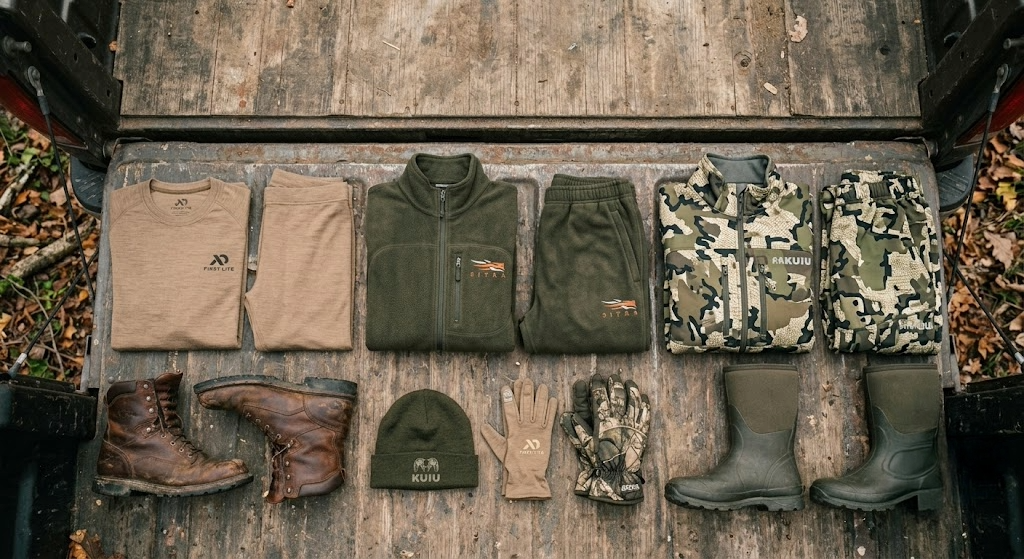
The wrong clothing ends hunts faster than bad luck. A cotton hoodie that holds sweat and kills your body heat by 8 AM. A stiff, noisy jacket that sounds like a grocery bag every time you shift in the stand. Boots that soak through on a creek crossing and leave you sitting with frozen feet for four hours. Every hunter has done at least one of these, and every hunter remembers the morning it cost them.
Knowing what to wear deer hunting comes down to understanding one concept: the layering system. No single outfit works from 70-degree September archery through 10-degree late-January muzzleloader. What works is three layers, each doing a specific job, that you add, remove, or swap based on temperature, activity level, and conditions. Get the system right, and you hunt comfortably from first sit to last, across a season that spans 40-plus degrees of temperature range.
Quick Picks: What to Wear Deer Hunting by Layer
Base layer (synthetic): Sitka Core Lightweight Crew. Quick-drying, Polygiene odor control, clean fit under mid layers. $109 to $135.
Base layer (merino): First Lite Kiln 250 Quarter Zip. Best merino all-rounder. Odor control that lasts 4-plus days without washing. $139 to $169.
Mid layer (active): KUIU Peloton 200. Synthetic fleece that dries fast and insulates well for active still-hunting. $129.
Mid layer (stationary cold): Sitka Fanatic Jacket. Purpose-built whitetail insulation for a treestand sit below 30 degrees. $369.
Outer layer (all-around): KUIU Axis Hybrid Jacket. Quiet, weather-resistant soft shell that covers October through January. $229.
Boots (dry ground): Danner Pronghorn. Ankle support and aggressive tread for ridges and steep terrain. $200 to $260.
Boots (wet/cold): LaCrosse Alphaburly Pro. Rubber, waterproof, insulated. Handles creeks and cold sits. $170 to $220.
The Three-Layer System Explained
Every deer hunting clothing system is built from three layers. Each one does a different job, and skipping any one of them breaks the whole system.
Base layer: Worn next to skin. Wicks moisture (sweat) away from your body to keep you dry. A wet base layer kills your body heat faster than cold air alone.
Mid layer: Traps warm air between your base and your outer shell. This is where insulation lives. The thicker or loftier the mid layer, the warmer you stay. Match the thickness to the temperature and the activity level.
Outer layer: Blocks wind, sheds rain and light snow, and stays quiet against branches and bark. The outer layer protects the insulation system underneath from the elements and from the noise that spooks deer at 20 yards.
That's the whole framework. The specific products you fill each slot with depend on your budget, brand preferences, and conditions. But the framework stays the same whether you're hunting 60-degree October archery in Georgia or 5-degree January muzzleloader in Wisconsin.
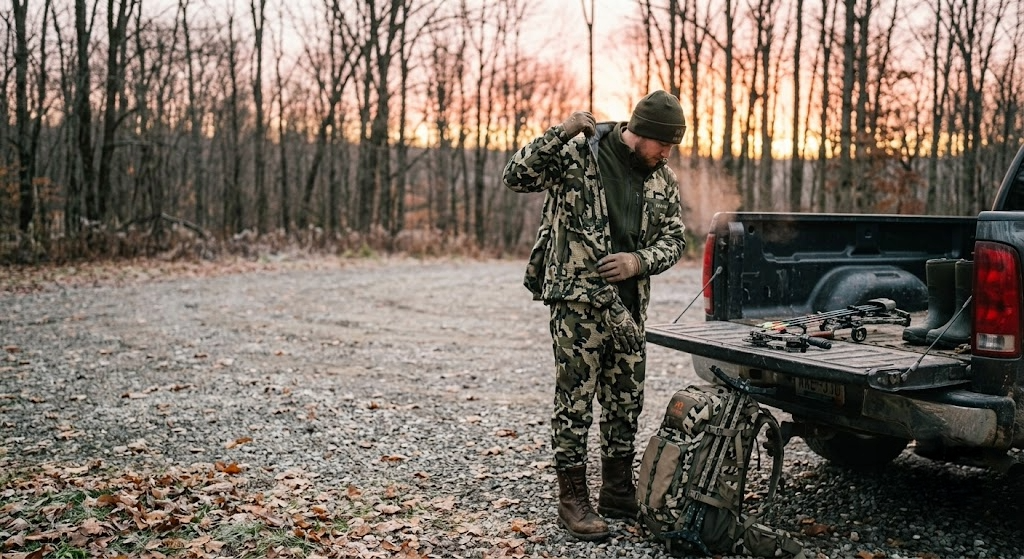
Base Layer: The Most Important Piece You'll Wear
Sitka Core Lightweight Crew
With the KUIU Peloton 97 discontinued, the Sitka Core Lightweight is the best synthetic base layer on the market. The smooth-knit polyester wicks fast and dries faster than any merino option. Sitka's Polygiene antimicrobial treatment controls odor better than untreated synthetics, narrowing the gap between synthetics and merino on single-day hunts. The fit is clean and athletic, layering under mid layers and shells without bunching or riding up.
I've personally shifted most of my base layer rotation from merino to synthetics over the past few seasons. I run an ozone generator to sanitize my hunting clothing before every sit. Once odor is handled externally, synthetics win in dry time and warmth per gram, while the Sitka Core Lightweight leads the synthetic category.
Honest limitation: After two full days without washing, a synthetic base layer smells worse than merino at the same stage. If you're on a multi-day backcountry trip without access to laundry or ozone, merino is still the better call.
Price: $109 to $135.
First Lite Kiln 250 Quarter Zip
The Kiln is the best merino base layer for deer hunting. The 250-gram Merino-X fabric sits in the sweet spot between warmth and breathability, working as a standalone on active hunts down to about 40 degrees and layering cleanly under mid layers when the temperature drops further. The odor control is the standout. After four consecutive days of wear without washing, the smell stayed manageable. No synthetic on the market matches that.
First Lite's Merino-X blend adds nylon for durability and spandex for shape retention. The Kiln holds its fit better over a week-long hunt than pure merino, which tends to stretch and sag after a few days of continuous wear.
Honest limitation: The 250-gram weight is too warm for early archery above 55 degrees. You'll overheat on any walk longer than a quarter mile. First Lite's Wick (150-gram) is the right pick for warm conditions. The Kiln also dries noticeably slower than synthetics.
Price: $139 to $169. Full base layer review on LandsToHunt.
Mid Layer: Matching Insulation to the Sit
KUIU Peloton 200
The Peloton 200 is a synthetic fleece mid-layer that provides strong warmth for the weight and dries very fast. For active hunting, still-hunting on public land, walking between stand locations, or any situation where you generate body heat on the approach and then sit in the cold, the Peloton 200's fast dry time prevents the post-hike chill that heavier mid-layers create. The fit runs slightly loose, which gives you room to layer a thick merino base underneath without binding.
In the 25 to 40-degree range, the Peloton 200 under the KUIU Axis Hybris jacket is the combination I run most often. Warm enough for a 4-hour morning sit. Breathable enough that the walk-in doesn't soak me.
Honest limitation: Below 20 degrees on a stationary treestand sit, the Peloton 200 doesn't insulate enough. You need a heavier puffy mid-layer or the Sitka Fanatic for the truly cold days.
Price: $129.
Sitka Fanatic Jacket
The Fanatic is purpose-built for whitetail treestand hunting in cold weather. The insulated construction traps more heat than the Peloton 200, and the articulated fit is designed to work at full draw without binding across the shoulders. Sitka's Gore Optifade Elevated II pattern is designed specifically for above-ground concealment. The Fanatic bibs (sold separately) complete the system and are one of the best whitetail-specific garments on the market.
Honest limitation: The Fanatic is too warm for anything above 35 degrees. Wearing it on a 45-degree October afternoon turns a deer hunt into a sauna. And at $369 for the jacket alone ($399 for the bibs), the investment is significant. This is late-season, cold-weather-only gear. Check out the Kuiu vs. Sitka article for more.
Price: $369 jacket, $399 bibs.
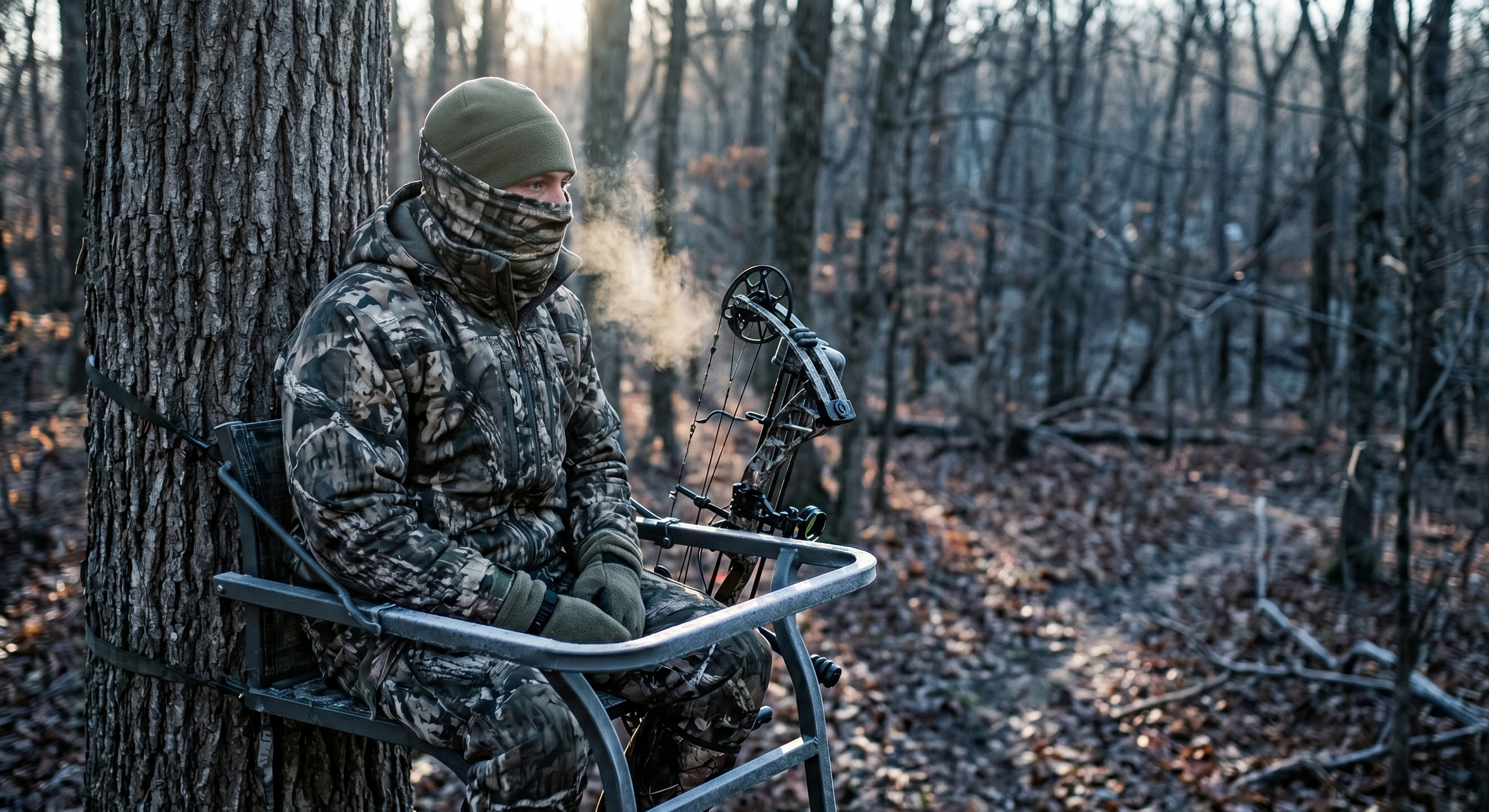
Outer Layer: The Shell That Makes or Breaks the Hunt
KUIU Axis Hybrid Jacket
The KUIU Axis Hybrid is the outer layer I trust for whitetail hunting and the one I recommend to anyone who asks, "What should I wear deer hunting?" and wants a single answer. The soft-shell face fabric is dead quiet against branches, bark, and tree stands. The DWR finish sheds light rain and wet snow. The fit layers over a base and mid without restricting draw length. And the Vias camo pattern works in every hardwood timber type from September through January.
I've worn the Axis Hybrid across hundreds of sits in Michigan over multiple seasons. On a 30-degree November morning with a Peloton 200 underneath and a merino base, the system keeps me comfortable through a 4-hour morning sit. On a 50-degree October afternoon, the Hybris goes on over just a base layer and handles the light wind and temperature drop at sunset.
Honest limitation: The Axis Hybrid is not rain gear. In sustained rain, the DWR finish wets through within an hour, and you'll need a dedicated rain shell over the top. For that, see the rain gear review. The soft-shell construction also shows wear faster than heavier hardshell fabrics in high-abrasion zones like forearms and seat panels on saddle hunters. Plan on a two to three-season lifespan with heavy use.
Price: $229.
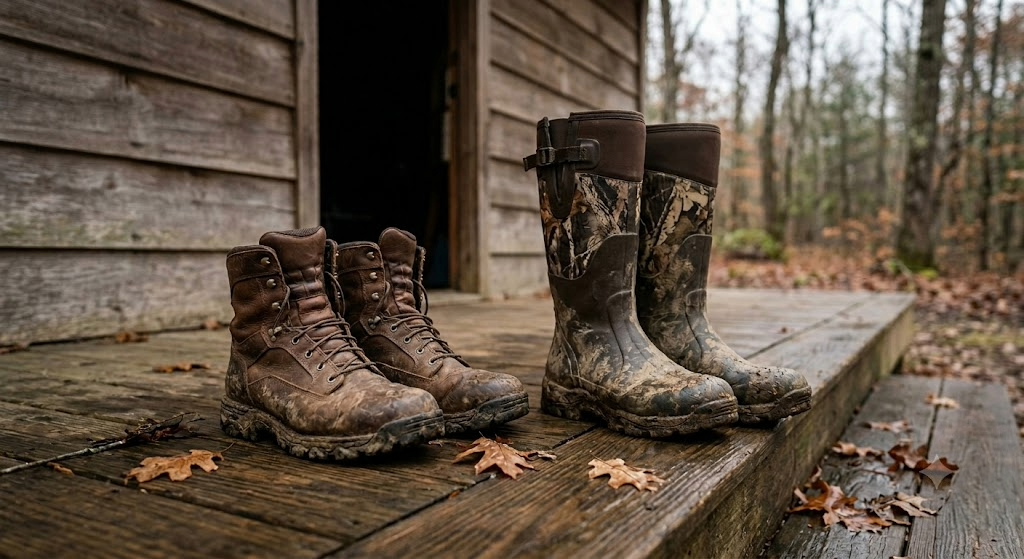
Boots: The Gear That Ends Hunts When It Fails
Danner Pronghorn
The Danner Pronghorn is the best all-around hunting boot for dry-ground terrain. Ankle support and aggressive tread handle steep ridges, loose shale, and leaf-covered slopes. Available in 400g, 800g, and 1200g Thinsulate insulation, so you can match the boot to your season. I run the 800g from late October through December in Michigan, and it covers the range without making my feet sweat on warm mornings or freeze on cold ones.
Honest limitation: The Pronghorn is not a wet-ground boot. Creek crossings and standing water will soak through the leather and Gore-Tex lining over time. For wet conditions, you need rubber.
Price: $200 to $260, depending on insulation weight.
LaCrosse Alphaburly Pro
The LaCrosse Alphaburly Pro handles everything the Danner can't: creek crossings, standing water, swamp edges, and cold-weather sits where waterproof insulation matters more than ankle support. The rubber construction keeps your feet dry in conditions that destroy leather boots in a single season. Available in 800g and 1600g insulation. For all-day late-season sits below 25 degrees, the LaCrosse Hunt Pac Extreme with 2000g insulation is the next step up.
Honest limitation: The Alphaburly Pro is heavy. The rubber construction trades weight for waterproofing, and your feet feel it on a mile-long walk in. The sole tread is adequate on moderate terrain but doesn't grip as well as the Danner on steep, loose rock. For mountain-style terrain, the Danner is the better boot. For everything else, the LaCrosse covers it.
Price: $170 to $220.
Accessories That Complete the System
Gloves
Carry two pairs. A thin merino or synthetic liner glove for the walk-in and for shooting (you need trigger feel through the glove). A heavy insulated glove or mitten with a flip-back finger for cold weather, where you're not at the ready. Switch between them as the temperature and the action dictate. Don’t underestimate the effectiveness of a hand muff. I don’t leave the barn without it. You can’t go wrong with the Sitka Jetstream or the Kuiu Proximity.
Head and face
A fleece or merino beanie covers most conditions. For extreme cold, add a balaclava or neck gaiter. For archery, a camo face mask or the Sitka Equinox Guard Hoody with its built-in face cover provides concealment without an extra piece to manage. Don't forget your ears. Cold ears end concentration.
Blaze orange
During firearms season in most states, you're required to wear 400 to 500 square inches of blaze orange above the waist, including a hat. Check your state's specific requirements. Build your orange around a vest and beanie that layer over your hunting system. Buy them in advance. Don't scramble the night before the opener.
What to Wear by Temperature Range
Above 55°F (early archery): Lightweight base layer only (First Lite Wick or KUIU ULTRA Merino 120). No mid-layer. The Axis Hybris goes in the pack in case the temperature drops at sunset.
40 to 55°F (October through early November): Midweight merino base (First Lite Kiln 250). Light fleece mid (KUIU Peloton 200), optional depending on activity level. Axis Hybris outer.
25 to 40°F (peak rut, firearms season): Midweight base. Peloton 200 mid layer. Axis Hybris outer. This is the combination that covers most of the deer season in most of the whitetail range.
10 to 25°F (late season, northern states): Heavyweight base. Heavy insulated mid (Sitka Fanatic or equivalent puffy). Wind-blocking outer. Step up to 1600g boots.
Below 10°F (extreme late season): Everything above plus hand warmers, a balaclava, and the LaCrosse Hunt Pac Extreme with 2000g insulation. At this temperature, your clothing system is being tested, and any weak link ends the sit.
What Doesn't Matter as Much as You Think
Camo pattern
Deer detect movement and outline, not whether your camo matches the specific bark of the tree you're sitting in. Sitka's Optifade, KUIU's Vias, First Lite's Fusion, and Realtree all work. Pick one pattern you like and build your system around it. Mixing patterns doesn't hurt your concealment. Wearing a camo that's quiet and functional matters far more than wearing a camo that's "right" for your region.
Scent-control clothing
No clothing technology eliminates human scent. Activated carbon, silver-infused fabrics, and proprietary scent treatments help at the margins, but none of them replace playing with the wind. Spend your scent-control dollars on rubber boots for the walk-in, scent-free detergent for washing, and an ozone generator if you want to take it further. Don't pay a $100 premium on a jacket because the label says "scent-eliminating." Play the wind.
Budget Pick Spotlight: Building a System Under $300
If the premium brands are out of reach right now, you can build a functional deer hunting clothing system for under $300:
Base layer: RedHead Elite Midweight from Cabela's, $50 top and bottom
Mid layer: Any quiet fleece jacket in earth tones, $40 to $60 at a big-box retailer
Outer layer: A DWR-treated soft-shell jacket from a hunting or outdoor brand, $60 to $100. Look for quiet face fabric and a fit that allows drawing without binding.
Boots: Rubber boots with 400g to 800g insulation from a farm supply store, $60 to $100
This system won't wick as well, insulate as efficiently, or last as many seasons as the premium options. But it keeps you dry, warm, and quiet enough to kill deer. Upgrade one layer at a time as budget allows, starting with the base layer (the biggest comfort difference) and the boots (the biggest endurance difference).
Frequently Asked Questions
What should a beginner wear deer hunting?
A moisture-wicking base layer (avoid cotton), a quiet fleece mid layer, and a soft-shell outer layer that blocks wind and stays quiet against branches. Add rubber boots, a blaze-orange vest, and a blaze-orange hat for firearms season. You don't need $1,000 worth of premium camo to start. You need dry, warm, and quiet. Build from there.
Is cotton okay to wear for deer hunting?
No. Cotton absorbs sweat and holds it against your skin, which drops your body temperature fast once you stop moving. "Cotton kills" is a real saying in outdoor clothing for a reason. Any synthetic or merino fabric wicks moisture away from your body and dries faster. Replace every cotton piece in your hunting wardrobe with a wicking alternative. This is the single biggest clothing upgrade a new hunter can make.
How many layers should I wear deer hunting?
Three is the standard: base, mid, outer. In warm conditions (above 55°F), drop the mid layer and wear just a base under the outer shell. In extreme cold (below 15°F), add a second mid-layer (a puffy over a fleece) between your base and outer layers. The system flexes by adding and removing mid layers based on temperature. The base and outer stay consistent.
Do I need different clothes for archery and gun season?
Not entirely, but you need to add blaze orange for gun season (state-specific requirements, usually 400 to 500 square inches above the waist). The biggest practical difference is noise. Archery hunters need quieter fabric because deer are close and alert. Gun hunters can tolerate louder materials because shot distances are longer. If you buy one outer layer, buy it quiet enough for archery, and it works for gun season too.
How much should I spend on deer hunting clothing?
A functional system starts around $250 to $300 using mid-range brands. A premium system from KUIU, Sitka, or First Lite runs $800 to $1,200 for base through outer layer plus boots. The price difference buys you better wicking, better odor control, quieter fabric, and longer lifespan across seasons. If the budget is tight, start with the best base layer and boots you can afford. Those two pieces have the biggest impact on comfort and hunt endurance. Upgrade the mid and outer layers as budget allows.
This article contains affiliate links. LandsToHunt.com earns a small commission on qualifying purchases at no extra cost to you.
