Saddle Hunting Setup Guide: Build a Mobile System for Public Land
This guide includes affiliate links. LandsToHunt.com earns a commission on qualifying purchases.
On most public ground, the best tree isn't the one with a rusty ladder stand chained to the trunk. Mine usually sits a few hundred yards past that stand. Think crooked white oak on the edge of a cedar thicket, in a spot nobody else bothers to walk to. I get there with a saddle, three sticks, and a platform that fits in a daypack.
This saddle hunting setup guide walks through every piece of that kit. You'll learn how the parts connect, how to climb and hang safely, and how to shoot once you're up there. After that, we'll price out a budget build and a premium build so you can match the system to your wallet.
Saddles aren't magic. They're lighter and quieter than hang-ons and far more flexible than climbers, but they punish anyone who skips practice. So we'll cover practice too.
What a Saddle Hunting Setup Includes
Strip a saddle system down and you've got six parts. A weak link anywhere shows up fast when you're 18 feet up in the dark.
Saddle: the padded webbing seat that wraps your lower back and thighs
Bridge: the short rope or webbing loop across the front of the saddle where your tether connects
Tether: the rope that wraps the tree above your head and holds your weight while you hunt
Lineman's rope: the rope that keeps you attached to the tree while you climb and descend
Platform or ring of steps: what your feet stand on at hunting height
Climbing method: sticks, a single stick with aiders, or strap-on steps
The Saddle and Bridge
Forget the idea of a seat. You lean back into the tree and let the saddle carry your weight. Your feet rest on the platform, your backside hangs in the webbing, and you can rotate almost all the way around the trunk. That's the whole trick.
For a new saddle hunter, I'd start with the Tethrd Phantom XP Saddle. The Phantom XP is the current version of Tethrd's Phantom, a saddle line built around long-sit comfort, easy adjustment over late-season layers, and a bridge that gives you wide range around the tree. Cost is the drawback. Plan on roughly $400 for the saddle alone, before you buy a single stick.
Whatever brand you choose, buy a saddle that meets Treestand Manufacturers Association (TMA) standards. Then check the bridge before every hunt. Fuzzing, glazing, or a nick in the rope means you replace the bridge before you climb again.
Tether and Lineman's Rope
Your tether does the heavy work. Most kits ship with around 25 to 30 feet of 10mm or 11mm low-stretch rope plus a prusik loop or friction hitch, so you can slide the connection up or down and lock the hitch under load.
The lineman's rope is shorter, with a different job. Wrap the rope around the tree, clip both ends to the side loops on your saddle, and lean back while you hang sticks. Utility linemen have climbed poles this way for decades. Saddle hunters just borrowed the idea.
A mechanical adjuster like the Wild Country Ropeman 1 lets you tighten or loosen the lineman's rope with one gloved hand, and that's a real advantage on a cold, quiet climb. The toothed cam wears rope faster than a friction hitch does, though. Inspect your line more often if you run one.
Platforms vs a Ring of Steps
For four or five hours, your feet need somewhere to live. A platform gives you room to shift weight and turn, which matters more than you'd think on an all-day sit during the public land rut. Tethrd's Predator Platform is a well-reviewed option with a large, stable footprint. Expect to pay north of $200, and know that the Predator adds bulk to your pack.
A ring of steps is the lighter, cheaper route. Strap three or four steps around the trunk at the same height and pivot your feet from step to step. Your arches will complain after a couple hours.
Good gear matters less than good ground. I built Hunting Scout so you can scout a spot from home before you buy a thing. Real terrain, water, boundaries, and wind for any location. 3 free reports a month. Run a free scout report
Choosing a Climbing Method for Your Saddle
How you get up the tree affects weight, noise, speed, and how many trees you can realistically hunt. Pick based on how far you walk and how much practice time you'll put in.
Climbing Sticks
Most saddle hunters start here. Three or four sticks, each roughly 20 to 32 inches long, get you to 15 to 20 feet with room to spare. Double-step designs are easier on your feet and calves than single-step sticks.
On the budget side, the Hawk Helium 30″ Climbing Stick 3-Pack – Gen 2 is the newest version of a stick set that's gotten a lot of saddle hunters off the ground. You get three 30-inch aluminum sticks that nest together for the walk in. Longer sticks mean more height per stick and fewer straps to fight with in the dark. Let them bump together on the walk, though, and they clank. Wrap the contact points with foam or rubber before season.
The One-Stick Method
One stick plus adjustable webbing aiders, or one stick you reposition as you climb. That's the entire kit. The Tethrd One Stick is built for this style, very light and very fast once you've got the motion down.
Getting there takes work. Your first dozen climbs will feel awkward and slow, and many one-stick hunters carry a rappel setup for the descent. If you're new to saddles, master sticks first.
Strap-On Steps and Public Land Rules
Strap-on steps pack small and work on trees that don't take sticks well. Screw-in steps are a different story. Many WMAs, state forests, and national forests ban screw-ins or anything that damages bark, and some cap how long you can leave gear in the woods. The U.S. Forest Service generally prohibits damaging trees on national forest land, and individual forests post their own stand rules. Read your state agency's regulations before you buy steps or leave anything hanging overnight.
Saddle Hunting Setup Guide: Step by Step From the Ground Up
Here's the sequence I run on every climb. Practice in your backyard until you can do this in the dark without thinking.
Pick the right tree. Look for a live tree roughly 8 to 20 inches across at hunting height, with bark that holds a strap. Mature oaks, hickories, and maples work well. Mark candidates during scouting with onX Hunt so you can find them again at 5 a.m. Our guide on how to scout public land covers what makes a tree worth climbing.
Gear up at the base. Saddle on, pack off, sticks unhooked and ready. Wrap the lineman's rope around the tree and clip both ends to your saddle before your feet leave the ground.
Hang the first stick at knee to waist height. Step up, slide the lineman's rope to about chest height, lean back, and hang the next stick.
Keep the lineman's rope high. Every time you move up, move the rope up. A rope that sags below your waist lets you fall farther if a boot slips.
Set the platform. At your top stick, strap the platform to the tree so the deck sits about level with your top step.
Set the tether before you unclip anything. Wrap the tether around the trunk as high as you can reach, clip the tether to your bridge with a locking carabiner, and slide the prusik to take out slack. Only then do you remove the lineman's rope.
Haul up your bow or gun. Use a haul line clipped to your saddle. Bows come up pointed away from your body. Guns come up unloaded with the action open.
Settle in and test. Lean back, let the saddle take your weight, and adjust the bridge and tether until your feet sit flat on the platform.
Coming down runs the same sequence in reverse. Lineman's rope goes on before the tether comes off. No exceptions.
Setting Tether Height
New saddle hunters almost always set the tether too low. A low tether drops you into a deep, sagging lean that jams your knees into the trunk and makes standing a chore. Set the tether a few inches above your head instead. You'll hang more upright, stand with less effort, and swing around the tree smoothly when a deer shows up on the wrong side.
How to Shoot From a Saddle
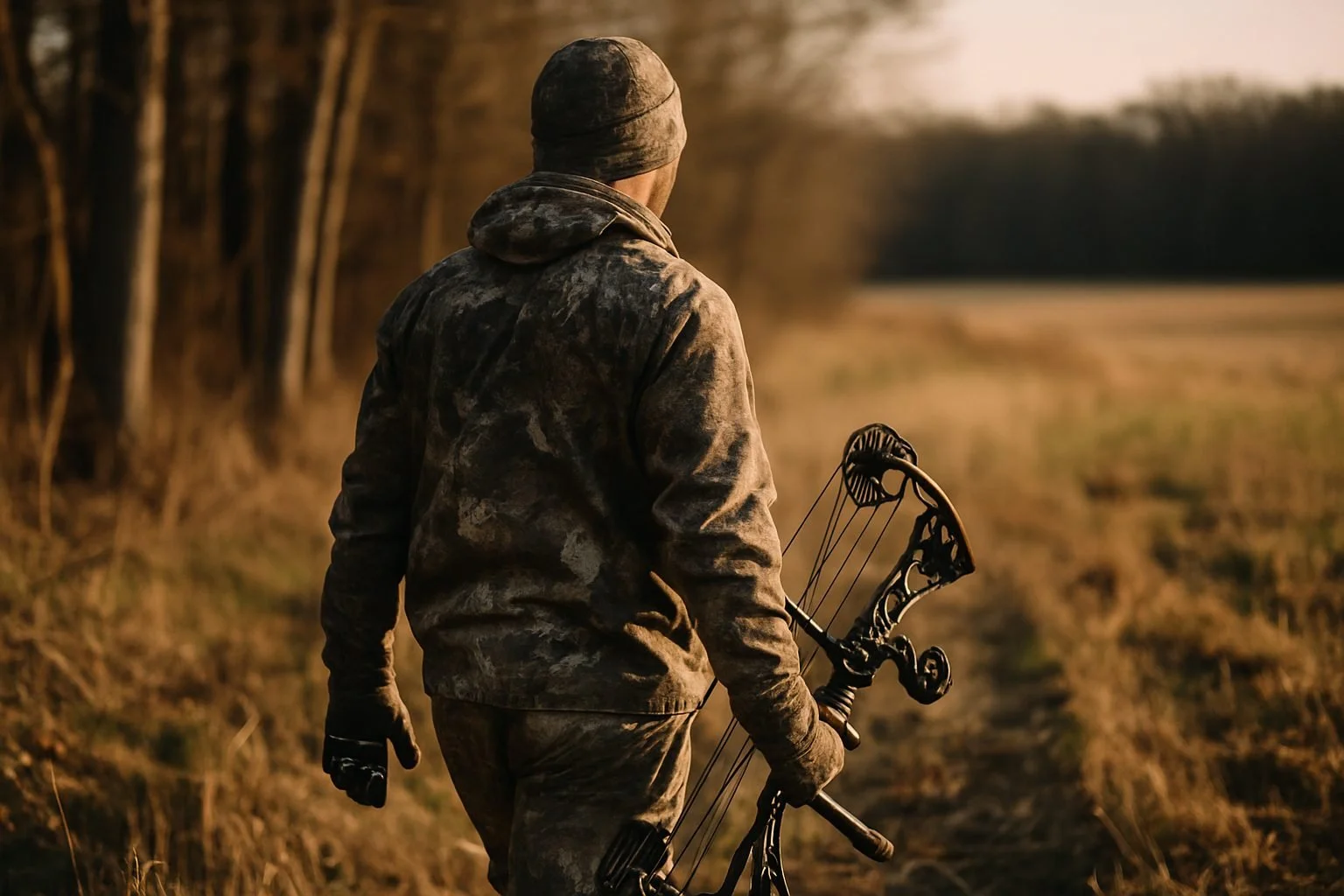
Saddles earn their reputation right here. You face the tree, and the trunk becomes a shield that breaks up your outline. When a deer comes in, you rotate around the tree to shoot.
For a right-handed bowhunter, the strong side is to your left. Pivot, lean out, draw. The weak side, to your right, takes real practice because you have to swing your body around the trunk and push your bow arm out at an awkward angle. Lefties, flip that.
Practice at Three Feet
Set your platform three feet off the ground on a backyard tree and put a target at 15 to 25 yards. Shoot from the strong side, the weak side, and straight behind the tree. Wear your hunting clothes, because a bulky jacket changes your anchor and your string clearance.
I tell people to log 20 practice climbs and a few hundred practice arrows before opening day. Sounds like a lot. That's the difference between hunters who love their saddle and hunters who sell the whole kit on a forum in October.
Saddles for Gun Hunters
Rifle and shotgun hunters get the same benefits. A tree-mounted shooting rest or a short monopod braced on the platform steadies your shot. Sling the gun across your chest while you settle in, and rehearse your standing and seated shooting positions before season.
Saddle Hunting Safety Rules I Don't Break
Tree stand falls rank among the leading causes of serious hunting injuries in the country. A saddle keeps you connected to the tree the entire time, but only if you follow the system on every single climb.
Stay connected from the ground to hunting height and back down. Lineman's rope or tether, always one, often both.
Use locking carabiners rated for life-safety use, not the cheap clips from the hardware store checkout lane.
Inspect your bridge, tether, prusik, lineman's rope, and stick straps before every hunt.
Replace soft goods on the manufacturer's schedule, and immediately after any fall or shock load.
Carry a way down if something goes wrong. Many saddle hunters pack a rappel device and enough rope to reach the ground.
Drop a pin on your phone and send the location to someone before you walk in.
Skip the climb when trees are iced or the bark is soaked and slick. No buck is worth that.
Budget vs Premium Saddle Hunting Setup
You don't need a $1,200 kit to start. Here's how the two builds stack up.
The Budget Build (Roughly $400 to $550)
An entry-level, TMA-certified saddle in the $150 to $250 range
The Hawk Helium 30″ Climbing Stick 3-Pack – Gen 2 for the climb
A ring of three or four strap-on steps instead of a platform
Prusik hitches on both ropes instead of mechanical adjusters
This build gets you in the tree safely and hunting mobile. Expect more weight, more noise, and less comfort on long sits. Plenty of good hunters run this exact kit for years anyway.
The Premium Build (Roughly $900 to $1,200)
The Tethrd Phantom XP Saddle
The Tethrd Predator Platform
The Tethrd One Stick with aiders, or a set of lightweight premium sticks
A Wild Country Ropeman 1 on the lineman's rope
What you're paying for is weight, quiet, and comfort. On a mile-and-a-half walk to a national forest ridge, every ounce and every clank adds up. Walking 300 yards into a WMA creek bottom? The budget kit does the job just fine.
My advice is simple. Spend on the saddle first, the platform second, and the sticks last.
Common Saddle Setup Mistakes
Skipping backyard practice. Your first climb shouldn't happen in the dark on opening morning.
Underdressing. Wind wraps around you in a saddle, and the webbing compresses insulation under your legs. Dress one layer warmer on your lower half than you would in a hang-on.
Hanging too high. Fifteen to 20 feet with good back cover beats 28 feet in a bare pole of a tree.
Carrying a noisy kit. Walk your driveway with a fully loaded pack and listen. Every rattle you hear there, deer hear on the walk in.
Hunting one tree all season. Mobility is the reason you bought a saddle. Read fresh sign and move with the deer, the way we lay out in how to hunt whitetail on public land.
Saddle Hunting Setup Guide FAQ
Is saddle hunting safer than a tree stand?
Saddle hunting is very safe when you follow the system, because you stay connected to the tree from the ground up. Most stand falls happen while climbing or transitioning into the stand, and a lineman's rope covers that gap.
How high should you hang a hunting saddle?
Fifteen to 20 feet works for most public land setups. Back cover and a clean shot angle matter more than raw height.
How much does a complete saddle hunting setup cost?
A safe budget setup runs roughly $400 to $550. A premium, lightweight kit runs about $900 to $1,200.
Do you need a platform for saddle hunting?
No. A ring of strap-on steps or the top step of your last stick works. A platform adds comfort and stability on long sits.
Can you saddle hunt with a rifle or shotgun?
Yes. Brace a monopod or tree-mounted rest on the platform, sling the gun across your chest while you settle in, and always haul the gun up unloaded with the action open.
Once your saddle hunting setup feels like second nature, every good tree on public ground turns into a potential stand. Find your next piece of ground in our state-by-state public land directory, then subscribe to the LandsToHunt email list for free state-by-state public land hunting guides delivered straight to your inbox.
Want a head start on the ground itself? I built Hunting Scout to scout any spot from home. Your first 3 reports each month are free. Try Hunting Scout
