This guide includes affiliate links. LandsToHunt.com earns a commission on qualifying purchases.
Every November, somebody at deer camp swears a buck "saw his orange." Somebody else swears deer are colorblind and orange doesn't matter. Both guys are half right. Once you know how deer see color, the argument goes away, and you know exactly where to spend money on camo and where to stop worrying.
Here's the short version. Whitetails see a narrower band of color than you do. They see blue and ultraviolet light better than you do, and they catch movement better than almost anything else in the woods. Orange isn't your problem. Your laundry detergent, your silhouette, and your fidgeting are.
How Deer See Color: The Science Behind Whitetail Eyes
Two Cones Instead of Three
Your retina runs three types of cone cells, tuned to short, medium, and long wavelengths of light. Blues, greens, reds. Your brain blends those three signals into every color you've ever seen.
Deer run two. In the 1990s, University of Georgia deer researchers teamed up with vision scientist Gerald Jacobs to measure whitetail cone sensitivity. They found peaks around 455 nanometers, which is blue, and 537 nanometers, which is green. No long-wavelength red cone showed up. That makes whitetails dichromats, with color vision roughly like a person with red-green colorblindness. The National Deer Association (formerly QDMA) has published solid summaries of this research if you want the deeper numbers.
What Two Cones Mean in the Field
Blues and violets look very vivid to a deer, often more vivid than they look to you.
Greens and yellows are visible but less separated from each other.
Oranges and reds look muddy and washed out, and deer have a hard time telling them apart from green or brown.
When you stare at a blaze orange vest, you see a neon warning sign. A deer sees something closer to a dull yellow-gray. Not invisible. Just not alarming as a color.
Deer See Into the Ultraviolet
Human eyes have a yellow-tinted lens that filters out most UV light before the light reaches the retina. Deer lenses filter far less. Combine that with a blue cone tuned to short wavelengths, and a whitetail picks up UV and blue light that looks like nothing special to you. Keep that fact in your back pocket. We'll come back to your washing machine in a minute.
Built for Low Light and Motion, Not Detail
Deer carry far more rod cells than cones, plus a reflective layer behind the retina called the tapetum lucidum. That's the eyeshine in your headlights. The whole setup gathers every scrap of light at dawn and dusk, which is exactly when you're sitting in the stand.
Detail is a different story. Most estimates put whitetail visual acuity around 20/100, so a deer sees fine detail at 20 yards about as well as you see at 100. Their cones and nerve cells also bunch up in a horizontal band across the retina called the visual streak. Because their eyes sit wide on the sides of the head, deer cover roughly 300 degrees of view and catch a flicker of movement along the horizon almost instantly.
Fuzzy detail, excellent motion detection, strong blue sensitivity, weak red. Every decision below comes back to those four traits.
Want to know which stand fits tomorrow's wind before you leave the truck? I built Hunting Scout to answer exactly that, with scent cones, daily stand picks, and terrain shadow on legal light. 3 free reports a month, no card. Run a free scout report
Does Blaze Orange Spook Deer?
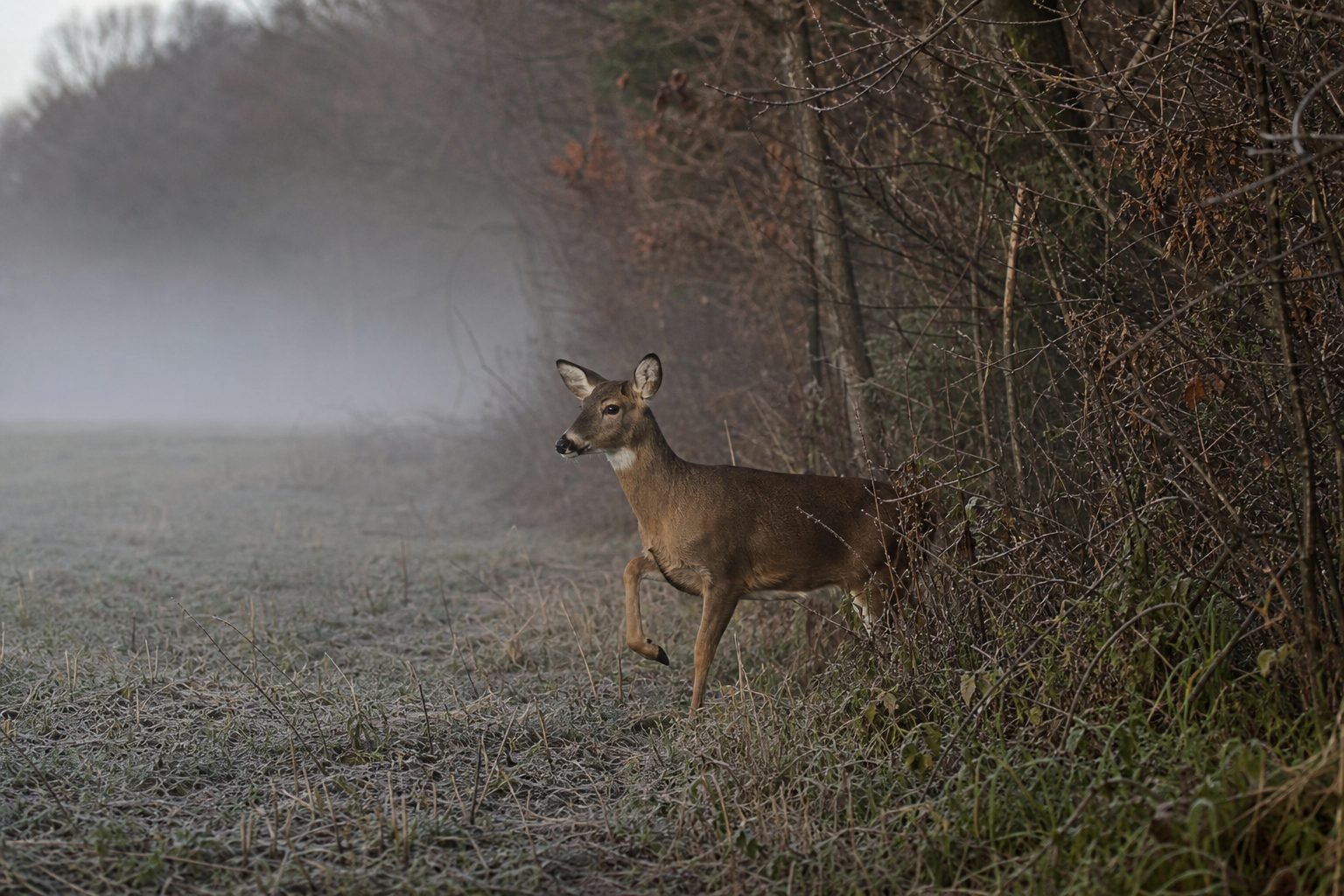
Short answer: the color itself isn't what gets you busted. Orange sits at roughly 590 to 620 nanometers, well past the peak of a deer's green cone. The light still registers, but as a weak signal with no distinct hue. Most researchers describe orange to a deer as something in the yellowish or grayish family.
Brightness is the catch. Fluorescent orange reflects a lot of light, so a solid orange vest shows up as a large, flat, lighter-toned block against a dark tree trunk. A deer doesn't need to read the color to notice a big shape that wasn't there yesterday. Add movement, and that shape becomes a problem fast.
Solid Orange vs. Camo Orange
Breakup helps. An orange garment printed with a camo pattern splits that bright block into smaller shapes, and shape matters a lot more to a deer than hue. Plenty of public land hunters I know switched to patterned orange years ago and noticed fewer deer locking up on them at 30 yards. Check your state's rules before you buy. Some states count camo orange toward the requirement, and others want solid fluorescent orange only.
What About Fluorescent Pink?
Wisconsin, New York, and Colorado are among the states that now allow fluorescent pink as a legal alternative to orange. Pink reflects more short-wavelength light than orange. Since deer see the blue end of the spectrum well, pink likely reads a little brighter to a whitetail. The difference is small. Wear whichever color your state allows and you'll wear consistently, because safety around other hunters comes first and both colors handle that job.
Know Your State's Orange Law
None of this changes the law. Pennsylvania, for example, requires 250 square inches of fluorescent orange on the head, chest, and back combined, visible from 360 degrees, during most firearms deer seasons. Other states set different minimums or require an orange hat specifically. Before every season, pull the current digest from your state wildlife agency, like the Pennsylvania Game Commission, and confirm what your weapon and season require. Our state-by-state public land directory links to every agency.
The Real Problem: UV Brighteners in Your Hunting Clothes
This is where knowing how deer see color should change your routine. Most household laundry detergents contain optical brighteners, chemicals that absorb invisible UV light and give the energy back off as visible blue light. That's what makes white shirts look "whiter than white." To you, the effect is subtle. To a deer with a sharp blue cone and a lens that passes UV, brightened fabric glows.
I learned this the hard way. A few seasons back, I took a cheap 365-nanometer blacklight flashlight into a dark closet and ran the beam over my gear. My jacket looked fine. The cuffs and collar of a camo hoodie that had gone through the family wash lit up like a scoreboard. That hoodie had been my go-to for early bow season on a creek-bottom ridge where deer kept picking me off at 25 yards. I'd blamed the wind all season.
How to Test Your Gear
Buy an inexpensive UV flashlight rated around 365 nm. Most cost under $20.
Take your hunting clothes into a completely dark room.
Sweep the light slowly over every piece, including gloves, hats, face masks, and pack straps.
Anything that glows bright blue-white has brighteners in or on the fabric.
How to Fix the Glow
Start washing hunting clothes only in a UV-free detergent. Atsko Sport-Wash is the one I keep in the laundry room. The formula has no brighteners and no perfume, so you knock out UV glow and added scent in the same load. The downside: brighteners already bonded to fabric take several washes to fade, and some never fully disappear.
For pieces that still glow, a UV-blocking spray like Atsko U-V-Killer coats the fabric and dulls the reflection. Plan on reapplying every few washes, because the treatment wears off. Keep hunting gear out of family loads, too. One wash with brightened towels leaves enough residue to undo your work.
Watch Out for Blue
Deer see blue so well that blue jeans, a navy hoodie, or a bright blue pack cover stand out far more than a red flannel shirt. If you hunt in jeans, swap them for brown or green pants. Those old-timers in red-and-black wool weren't as crazy as they look in the photos.
Choosing Camo Based on How Deer See Color
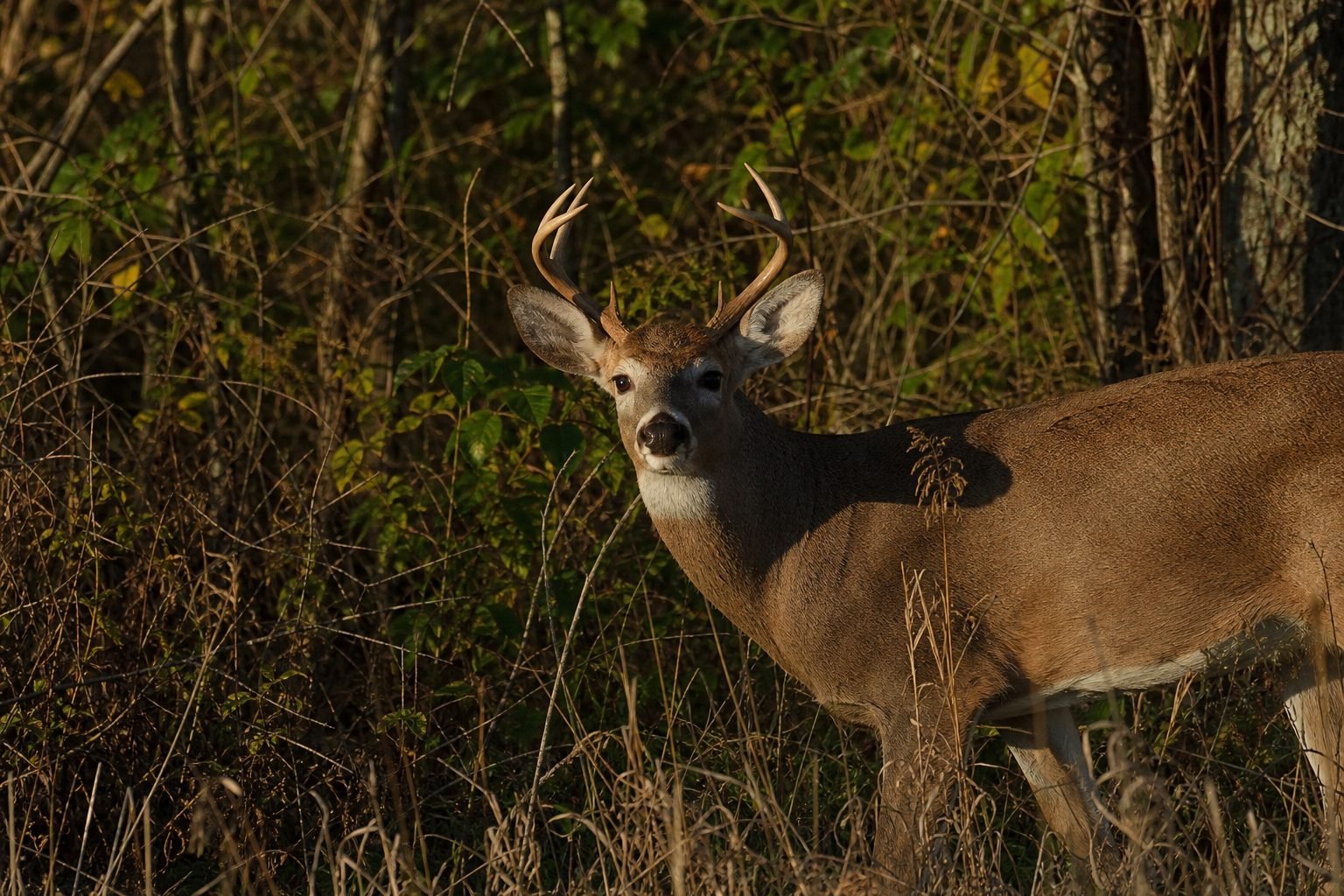
Once you understand how deer see color, camo stops being a fashion decision. A deer reads your outfit by brightness, pattern, and outline far more than by hue. The exact shade of green on your jacket matters less than whether the whole outfit turns you into a solid, human-shaped block.
Match the Value, Not the Hue
Value means how light or dark something reads. A deer struggles to separate olive from tan but has no trouble spotting a dark figure against a light background. So match the overall tone of your setting:
Early season hardwoods under full canopy: medium-to-dark patterns with lots of shadow
Late October and November timber: gray and brown tones that match bare trunks
Late season snow or pale CRP grass: lighter, open patterns
Cattails and marsh edges: tan-heavy patterns that blend with dead vegetation
Pattern Scale Matters at Distance
Remember that 20/100 acuity. Tiny, detailed leaf prints blur together into one flat tone past about 20 yards. Bigger, high-contrast breakup shapes hold up at bow and gun distances. That's why open, macro-style patterns tend to outperform photo-realistic leaf-and-twig prints for whitetails.
For a general public land setup, the KUIU Axis Hybrid Hooded Jacket in Vias is my default outer layer from mid-October through the rut. Vias uses large, blocky shapes that break up your outline at real-world distances, and the jacket stays quiet when you draw. The drawback is warmth. The Axis isn't built for long, frozen December sits, so you'll need a heavier insulating layer underneath once temps drop into the teens.
Silhouette Beats Camo Every Time
The best pattern on the market won't save you if you're skylined. A hunter perched on a skinny tree against open sky reads as a dark blob to any deer that glances up. Pick trees with a wide trunk, limbs behind you, and cover at your back. On the ground, sit in shadow with something solid behind you.
Saddle hunters get a real edge here. You hang tight to the trunk and rotate around the tree instead of standing out on a platform. The Tethrd Phantom XP Saddle keeps your profile tight to the bark and packs light for long walk-ins on public ground. Expect a learning curve. Your first few sits will feel awkward, so practice at ground level before you climb. Our saddle hunting setup guide walks through the details.
Movement: What Deer Spot First
Everything above matters. Movement matters more. A horizontal visual streak and a rod-heavy retina make a whitetail a motion detector first and a color detector a distant second. Deer pick up a hand lifting binoculars, a head turning to check the wind, or a bow arm swinging up. Often from 80 yards. Often from the corner of the eye, while the deer seems to be looking somewhere else.
Field Scenario: The November Ridge Sit
A few Novembers ago, I sat a saddle about 18 feet up a white oak on a hardwood ridge in Hoosier National Forest. Below me, two ridge spurs met at a bench, with a trail climbing out of the creek bottom. A steady northwest wind at 8 to 10 mph pushed my scent off the back side of the ridge. I wore Vias under a solid orange vest for the firearm opener.
At 7:40 a.m., a mature eight-pointer came up the spur trail, slow and nose down. He walked past broadside at 40 yards and never gave the orange a second look. My mistake came next. I started raising the gun while his head was still up, and he caught the motion instantly.
He locked onto me for what felt like five minutes. I froze with the stock halfway to my shoulder, arms burning. Eventually he dropped his head and took two steps, and when his eyes passed behind a big white oak trunk, I finished the move and made the shot.
The orange never mattered. Bad timing nearly cost me that deer.
Movement Rules That Work
Move only when a deer's head is down, behind cover, or turned fully away.
Raise your bow or gun slowly in one smooth motion, not in jerks.
Carry binoculars in a chest harness so you lift them a few inches instead of swinging a full arm.
Wear gloves and a face mask or head net. Bare hands and a pale face flash in low light.
Pick stand trees that put cover between you and the trail deer use most.
Spot Deer Before They Spot You
Good glass helps you win the motion game. Seeing a deer at 150 yards instead of 50 gives you time to get ready while small movements still don't register. The Vortex Diamondback HD 10x42 gives you clear, bright glass for picking apart timber edges at first light without premium pricing. At around 22 ounces, though, the 10x42 gets heavy around your neck on an all-day sit, so pair the binocular with a harness.
Putting Whitetail Vision to Work on Public Land
Public land deer see more people than private land deer, and pressured deer react faster to anything out of place. Knowing how deer see color matters even more when you share the woods with a dozen other trucks. Run this list before your next sit:
Blacklight-test every piece of hunting clothing, including gloves and hats.
Wash hunting gear separately in UV-free detergent.
Ditch blue jeans and blue-toned layers.
Choose camo by tone and pattern scale for your terrain and month.
Pick trees and ground setups with back cover so you're never skylined.
Wear the orange your state requires, in a patterned version where legal.
Time every movement to the deer's head and eyes.
For more on reading pressured deer and picking setups on shared ground, check out our guide on how to hunt whitetail on public land. Planning November sits already? Our public land rut hunting guide covers stand placement for the busiest weeks of the season.
How Deer See Color: Frequently Asked Questions
Can deer see blaze orange?
Deer detect blaze orange as light, but without the vivid hue you see. Lacking a red-sensitive cone, a whitetail most likely sees orange as a dull yellowish or grayish tone. Brightness and a solid, unbroken shape draw more attention than the color.
What color is hardest for deer to see?
Reds and oranges are the hardest colors for deer to separate from greens and browns, so they read as muted tones. Blue and ultraviolet are the easiest colors for deer to pick out.
Do deer see UV light on hunting clothes?
Yes. Deer lenses let in more UV light than human lenses, and a deer's blue-sensitive cone picks up the glow from optical brighteners in many laundry detergents. Washing in UV-free detergent and checking gear with a blacklight solves most of the problem.
Does camo pattern matter if deer are colorblind?
Deer aren't fully colorblind, but pattern matters more than color. Large, high-contrast breakup shapes in a tone that matches your surroundings hide your outline at hunting distances better than any exact color match.
Can deer see you if you don't move?
Usually not well. With visual acuity around 20/100, a deer has trouble picking out a still hunter with good back cover and no UV glow. Movement turns you from part of the tree into a threat.
Want more ground to put this to work on? Subscribe to the LandsToHunt.com email list and get our free state-by-state public land hunting guides, with WMA breakdowns, season timing, and access tips for the ground you hunt.
Want a head start on the ground itself? I built Hunting Scout to scout any spot from home. Your first 3 reports each month are free. Try Hunting Scout
